Localization workflows & operations
The case for human translation in an AI-first world
Localization workflows & operations

Table of content

A product team has 40,000 interface strings ready for a new market. At the same time, its communications team is preparing a CEO statement after a service disruption. Both sets of content need translation, but giving them the same treatment would make little sense. The first may be a strong candidate for AI translation with targeted review. The second needs professional human translation from the start.
That difference captures the case for human translation today. AI can produce useful translations at a speed and volume that human teams cannot match. Human translators still have an advantage when the work calls for interpretation, cultural knowledge, creative choices, or a person who can take responsibility for the result. This article explains when to use human translation, where automation earns its place, and how to combine both in one localization program.
Some defenses of human translation begin by minimizing what AI can do. Current systems can translate routine material, generate a first draft in seconds, and make content accessible when a fully reviewed translation would never fit the budget or deadline.
The European Commission illustrates this distinction on its own websites. It uses automated eTranslation when human versions are unavailable, while warning that quality can vary by text and language pair. It also directs readers to authentic versions of EU legislation rather than using machine translation for the law itself. Its published terms for machine-translated pages follow the purpose and consequences of the content.
Human translation earns its place when a text asks someone to decide what the source means in context and how that meaning should work for another audience. A machine generates an output from patterns and instructions. A professional translator can question an ambiguous sentence, research a reference, explain why a slogan fails in the target language, and ask the content owner to resolve a contradiction.
This contribution may appear as a comment, a query, or a deliberate departure from the source structure. Those interventions can prevent a polished translation from carrying the wrong message.
One organization may need several translation methods in the same week. A support archive, an advertising concept, a product release, and an employment policy differ in audience, shelf life, complexity, and cost of error.
The following table compares three production routes. These categories are starting points. Language pair, source quality, available reference material, and the performance of the chosen system can change the decision.
Translation route | Best suited to | Human responsibility | Typical examples |
|---|---|---|---|
AI translation | High-volume content used for orientation or discovery, with a low cost of error | Define acceptable use, protect sensitive data, and monitor output quality | Internal search, low-traffic knowledge content, first-pass understanding |
AI translation with human review | Structured or recurring content that needs publication quality but benefits from automation | Correct meaning and terminology, check context, and approve the final text | Product updates, help-center articles, standardized email campaigns |
Human-led translation | Content requiring interpretation, adaptation, subject expertise, or close accountability | Research, translate, raise queries, adapt where authorized, and approve | Brand campaigns, executive communication, sensitive HR material, contractual content |
The middle route covers a broad range of workflows, but “human review” needs a definition. A quick read for obvious errors differs from full post-editing by a qualified translator. The reviewer needs a clear quality target, access to the source, enough context, and authority to rewrite the output.
Fluency is visible. Judgment often is not. A translation can read smoothly while mishandling the speaker’s intent, the relationship between participants, or a term with a specific meaning inside an organization.
Research on hallucinations in multilingual translation models has documented output that is detached from the source. The 2023 study covered more than 100 language pairs and found particular difficulty in lower-resource directions and when translating out of English. Fluent output cannot serve as its own quality check.
Professional translators contribute several kinds of judgment:
Meaning in context: They resolve references, ambiguity, irony, and implied meaning using the full document and its purpose.
Audience fit: They choose the appropriate register, level of directness, and form of address for the intended readers.
Cultural interpretation: They recognize when an example, metaphor, or assumption will confuse or alienate the target audience and can propose an alternative.
Terminology decisions: They research domain terms, follow approved terminology, and flag a source term that lacks a stable equivalent.
Constructive resistance: They can challenge unclear source copy instead of reproducing its weakness in another language.
Responsibility: They can document their reasoning, respond to reviewer feedback, and stand behind a delivery against an agreed brief.
Professional human translation is a service rather than the simple production of target-language sentences. The translator works with instructions, references, terminology, previous decisions, and feedback. ISO 17100 specifies resources and core processes for translation services that meet client and applicable requirements; raw machine output with post-editing sits outside its scope.
A human-led workflow is justified when the cost of a subtle error outweighs the savings from generating a first draft automatically, or when adaptation is the primary task.
This table provides a practical routing test for content owners. A high score in one category may be enough to require human leadership; you do not need every condition to apply.
Decision factor | Signal for human-led translation | Signal that AI may take the first pass |
|---|---|---|
Consequence of error | A mistake could change obligations, harm trust, or mislead people at an important moment | An error would cause limited inconvenience and can be corrected quickly |
Interpretive demand | The text relies on voice, humor, implication, wordplay, or cultural references | The text is literal, repetitive, and supported by clear context |
Need for adaptation | The target version must work as original communication in its market | Close transfer of the source meaning is sufficient |
Source ambiguity | The translator must resolve unclear intent with the author or subject expert | The source is controlled, complete, and consistent |
Longevity and reach | The content will be reused, widely seen, or shape future terminology | The content is temporary, low traffic, or intended for gist understanding |
Accountability | A named specialist must approve and defend the language | Sampling and correction provide enough control for the intended use |
Brand language is an obvious example. A campaign headline may need a new image or sentence structure to create the intended response. A literal version can preserve every dictionary meaning and still fail as marketing.
Sensitive communication creates a different need. An announcement about layoffs, a safety incident, or employee benefits carries emotional and procedural consequences. The translator needs the relevant background and can ask whether a phrase is intentionally firm or accidentally harsh.
Legal and regulated content also calls for caution, although “human translated” does not automatically mean correct. The right professional needs subject expertise, a clear brief, current reference material, and an independent review process where required. Human involvement is valuable because it makes research, queries, revision, and responsibility possible.
Many teams have more content than their linguists can translate from a blank page. AI can expand coverage and reserve specialist time for work that benefits from it. The International Federation of Translators’ position on machine translation describes AI as a way to augment translators while warning about bias, inconsistent terminology, cultural limitations, and high-stakes use.
A combined workflow can take several forms:
AI produces a draft that a translator fully post-edits against defined requirements.
Translation memory supplies approved previous wording, while AI handles new segments and a linguist reviews them.
AI translates low-impact content, and human reviewers examine a risk-based sample rather than every sentence.
A translator creates the key campaign language, while AI helps propagate approved terminology across supporting material.
The choice should be explicit. Labeling every workflow “human in the loop” hides major differences in effort and assurance. Record which content receives full review, what reviewers check, who can approve it, and what happens when quality falls below the agreed threshold.
Reference material remains important in an automated workflow. The European Commission’s Directorate-General for Translation instructs contractors to correct errors even in exact translation memory matches and neural machine translation segments. Previous approval and automated generation are inputs, not proof that the current sentence is suitable.
AI reduces the value of spending expert time on predictable sentences that a system already handles well. It increases the relative value of decisions that depend on language expertise.
Translators may spend more time reviewing output, managing terminology, advising authors, designing quality criteria, and examining failures across a body of content. Some will specialize further, while others will help teams decide where automated output is acceptable and build the linguistic resources that improve it.
Review work still requires skill. Detecting a plausible mistranslation can be harder than translating the sentence directly because the reviewer must resist the wording already on the page. Organizations also need to account for concentration, suitable rates, and realistic throughput when assigning post-editing. Automation changes the task; it does not make sustained linguistic attention unlimited.
Human translators help define the intended meaning, test whether the target text achieves it, and preserve decisions for later content.
Content routing fails when the decision lives only in a policy document. The translation environment needs to carry the method, context, references, status, and approval path with the content.
LingoHub supports AI translation with human review as well as collaboration among translators, reviewers, developers, and product teams. Teams can use a glossary to keep approved terminology available, reuse previous translations through translation memory, and apply quality checks for placeholders, completeness, and terminology. These controls support human decisions; they do not determine whether a translation is appropriate for its audience.
We also support professional human translation within the localization workflow. That option matters because an AI-first product should not force an AI-only localization strategy. Teams need the freedom to use automation for suitable content and direct human attention to language with higher interpretive or reputational demands.
A workable policy names four things for each content class:
The permitted translation method.
The required review level and reviewer qualifications.
The linguistic assets and context that must accompany the job.
The person who approves publication and handles exceptions.
Revisit the policy using corrections, reviewer feedback, user reports, and changes in system performance. Content assigned to full human translation may become suitable for reviewed automation. A routine category may move in the other direction after repeated terminology or context errors.
Yes, when the content requires interpretation, adaptation, specialist knowledge, or accountable approval. AI is suitable for many routine and low-impact uses, but its fluency does not remove the need for judgment. The appropriate level of human involvement depends on the content’s purpose and the consequences of an error.
No method guarantees quality. A professional translator without context or relevant expertise can make mistakes, while a well-configured system may handle standardized content very well. Compare outputs against a defined purpose, language pair, audience, and quality threshold rather than assuming that the production method settles the question.
In human translation, the translator creates the target text from the source, often with support from translation memory and terminology tools. In post-editing, a person revises machine-generated output. Human translation services may offer either route, so buyers need to confirm how the work will be produced and reviewed. Both require language expertise, but post-editing also needs a clear quality target.
Classify content by consequence of error, interpretive demand, audience reach, lifespan, source quality, and need for accountable approval. Pilot the proposed workflow on representative material and have qualified reviewers assess the results. Use those findings to set routing rules, then monitor corrections and exceptions after launch.
Human translation has a durable role because some communication needs a person who can interpret, question, adapt, and accept responsibility. AI lets that expertise be applied more selectively, across a larger multilingual content program. Supporting both gives each piece of content the level of attention its purpose deserves.
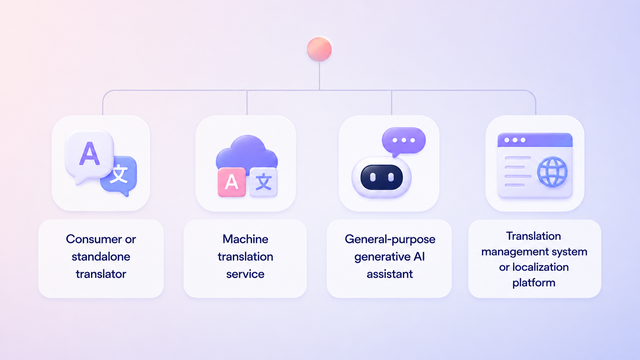
AI translation tools: how to choose the right setup
Compare AI translation tools by use case, quality controls, workflow fit, security, and review needs. Choose a setup for consistent multilingual content.
AI localization: what it is and how it works
AI localization translates and adapts software and content with your glossary, translation memory and style guide, while your team reviews what matters.
AI localization insights from the Nimdzi 100 2026 report
Explore the key findings from the 2026 Nimdzi 100 report, including AI localization, automation, human review, and the future of enterprise localization.