AI translation tools: how to choose the right setup
AI translation
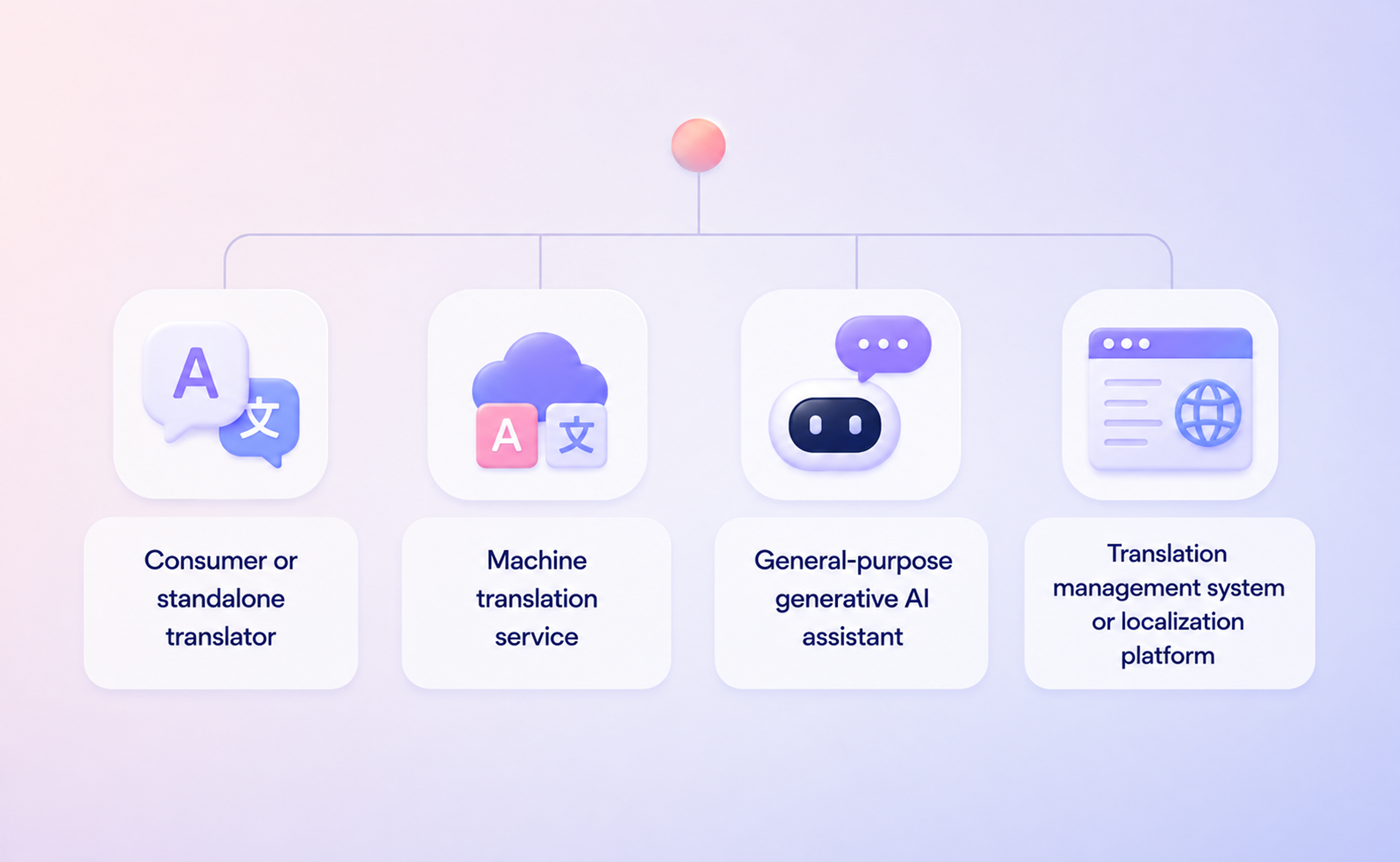
Table of content

The best AI translation tools fit your organization’s content, risk level, and approval process. A browser translator may be enough for understanding an internal note. More structured workflows, however, need terminology control, reusable translations, quality checks, secure data handling, and approval rules.
This blog article explains how to match AI translation tools with content and evaluate quality, security, workflow, and human review.
AI translation tools turn source content into one or more target languages. For this comparison, we distinguish between two options: neural machine translation and generative AI translation tools. Neural machine translation relies on models trained for language conversion. Generative tools apply large language models that can respond to instructions, examples, tone guidance, and broader context. Our article on how AI language translators evolved from SMT to neural models and LLMs explains the development.
A translation management system or localization platform manages language assets, engine requests, status, checks, and reviewer routing.
Tool category | Best fit | Main advantage | Main limitation to investigate |
|---|---|---|---|
Consumer or standalone translator | Ad hoc comprehension and low-risk, one-off text | Immediate output with little setup | Limited control over terminology, reuse, approvals, and data handling |
Machine translation service | High-volume translation embedded in an existing process | Predictable automation and broad language coverage | Requires another system or custom process for review, status, and publishing |
General-purpose generative AI assistant | Drafting brand-sensitive or context-rich content with detailed instructions | Flexible prompts, examples, and rewriting | Output can vary; language assets and approvals may remain outside the workflow |
Translation management system or localization platform | Recurring websites, products, help centers, and campaigns | Connects engines with assets, roles, QA, and content updates | Requires workflow design, ownership, and onboarding |
Content type establishes the first filter. Interface strings can be ambiguous without visual context; marketing copy needs room for tone and cultural adaptation. Internal messages may prioritize speed, but they can contain confidential information.
The table maps each content type to a suitable tool category, the capabilities to prioritize, and an appropriate review level.
Use case | Suitable starting setup | Capabilities to prioritize | Review approach |
|---|---|---|---|
Website pages | Localization platform connected to the content source | Change detection, page context, glossary, translation memory, staging, publishing control | Review high-traffic and conversion pages in layout |
Product interface | Localization platform with file or repository integration | String context, character limits, placeholders, version tracking, QA checks | Linguistic review plus in-product testing for key journeys |
Marketing campaigns | Context-aware generative translation inside a managed workflow | Style guide, campaign brief, approved claims, transcreation instructions | In-market brand review before launch |
Support content | Machine translation or generative AI connected to a content workflow | Translation memory, product glossary, update synchronization | Sample routine updates; review safety-critical instructions |
Internal communication | Approved enterprise translation service | Access control, retention terms, regional processing, identity management | Match review to confidentiality and consequence of error |
Classify content by the consequence of an error. This determines whether output can publish automatically, requires sampling, or needs a qualified linguist and subject-matter owner. Test the intended source language, target locale, content type, and direction.
Continuous website localization must track changing pages, reused labels, and market-specific publication schedules. A managed workflow routes source changes for translation, applies approved language assets, records review status, and returns completed content for staging or publication.
Evaluate AI translation tools based on paragraph changes, removed pages, and updated shared labels. Use an in-context preview or staging environment to find clipped text, awkward wrapping, and untranslated elements.
Generative systems can follow a campaign brief that defines audience, tone, fixed claims, and adaptable phrases. This helps with marketing headlines, onboarding messages, and conversational help content where several translations are valid.
Models may still vary repeated phrasing or change a number, negation, named entity, or required phrase. Provide only the context that resolves ambiguity, then protect mandatory content and route consequential output to review. Google’s adaptive translation uses example sentence pairs, while its glossary controls domain-specific terms.
Recurring content also needs translation memory. It preserves approved sentence-level choices across releases, while the glossary controls individual terms. Without these assets, a fluent model may vary established product wording from one page to the next.
A useful evaluation tests representative interface strings, repeated segments, ambiguous terms, formatted text, and product names.
Glossary: Define approved translations, protected names, and discouraged terms. Add a definition when a word has several meanings. “Plan,” for example, may mean a subscription tier or a project schedule.
Translation memory: Store approved sentence-level translations for reuse. Check which statuses feed the memory, how exact and partial matches appear, and whether the data can be imported and exported.
Context: Test whether the tool can provide translators and AI with descriptions, nearby text, screenshots, page URLs, audiences, and locales.
Style guide: Turn brand guidance into rules for formality, preferred address, capitalization, units, and brand names. Pair important rules with examples.
Automated checks: Find missing translations, changed placeholders, inconsistent terms, number mismatches, and character-limit violations. These checks cannot confirm that the message is correct for its audience.
Error categories: Define them before the pilot. ISO 5060:2024 covers human, post-edited machine, and unedited machine translation output by grouping errors by type and assigning a score based on their severity.
Approval roles: Assign them by expertise. A linguist judges meaning and locale usage; a legal, medical, product, or brand owner validates relevant domain claims.
Review depth: Match it to the impact of an error. NIST’s AI Risk Management Framework Core calls for documented human oversight and responsibilities. Stable low-risk content may use sampling, while contractual or safety-related content needs qualified approval.
Handoffs: Map every step from creation to publication. Check integrations, change detection, access controls, version history, and the path back to the content source.
Exceptions: Test whether a failed check or rejected translation remains visible and assigned when the source changes during review.
Cost and ownership: Compare setup, usage, linguistic review, maintenance, and rework. Confirm that translations, glossaries, and translation memory remain exportable.
The table links recurring translation issues to their likely causes and appropriate workflow responses.
Problem | Likely reason | Workflow response |
|---|---|---|
The same product term appears in several forms | No approved term, conflicting glossary entries, or glossary not applied | Assign a terminology owner, define the term by locale, and test enforcement |
Translation is fluent but means something different | Ambiguous source, insufficient context, or model variation | Add segment context, protect facts and numbers, and route consequential content to review |
Brand copy sounds generic | No usable style rules or relevant examples | Convert brand guidance into specific language rules and approved examples |
Previously approved sentences change | Translation memory is absent, ignored, or built from unapproved content | Reuse approved segments and restrict which statuses feed the memory |
Buttons or variables are damaged | Markup, placeholders, or character limits are not validated | Protect non-translatable elements and run automated checks before approval |
Outdated pages remain live in one language | Source changes are not linked to translation status | Connect the content source and reopen translations when relevant text changes |
Review becomes a bottleneck | Every item receives the same review depth | Classify content by consequence, sample stable low-risk output, and reserve specialists for high-risk items |
Fix recurring ambiguity in the source, then update the glossary or style guide. During the pilot, classify reviewer changes; only repeatable decisions belong in shared assets.
Verify security for the submitted content, selected deployment, and your organization’s obligations. Consumer interfaces, enterprise accounts, and APIs may have different terms.
Request evidence for:
Data handling: Verify location, retention, deletion, model-training use, and subprocessors.
Access and monitoring: Check encryption, identity controls, permissions, and audit logs.
Incident management: Review notification terms and regional processing options.
For personal data governed by the GDPR, European Commission guidance requires processors to provide sufficient guarantees and operate under a contract or other legal act. Apply the Commission’s processor obligations guidance with your privacy and legal teams.
Verify the selected service rather than assuming one policy covers every product. Microsoft states that Azure Translator text requests are not stored and document data is removed after processing.
Create an approved-content policy for public copy, customer or employee records, legal documents, financial information, and health data.
We hold ISO 27001 and SOC 2 Type II certifications. On our security page, we document European hosting, encrypted processing, access controls, and audit capabilities.
Certification provides evidence about vendor controls. Your assessment still has to cover content, permissions, configuration, and review within your own deployment.
Compliance follows from the use case, data, contracts, controls, and human responsibilities. Request audit reports or certifications, data-processing terms, subprocessors, retention controls, hosting regions, and incident procedures for the exact product and plan.
Document the intended use, excluded content, approved languages, review thresholds, and owners. NIST’s voluntary Generative AI Profile supports cross-sector management of generative AI risks.
Run a pilot with representative locales, repeated strings, ambiguous terms, formatting, and each risk tier. Remove sensitive data until the service passes security review.
Define error severity, review effort, and publishing criteria before seeing output.
Supply an approved glossary, style guide, and translation memory.
Test translation, review, a source change, and publication.
Count severe errors, edits, formatting issues, and reviewer minutes by locale.
Test a changed placeholder, rejected segment, and revoked access.
Compare the results with the agreed thresholds.
Report results by severity and content type. Ten clean sentences do not neutralize one incorrect safety instruction.
Our AI translation workflow uses project language assets and keeps AI output, automated checks, and human review in one workspace.
Teams can define terms in a glossary and reuse approved segments through translation memory. Quality checks flag missing translations, changed placeholders, formatting problems, and inconsistent terms.
LINA combines translation and review with project context. The workflow still needs owners, approved language assets, review rules, and a representative pilot.
Our articles on AI and human translation as a collaborative workflow and AI orchestration in localization show how automation and reviewer routing can share one process.
The best choice matches the content, language pair, risk, and workflow. A standalone translator fits low-risk comprehension; recurring multilingual publishing benefits from a localization platform with terminology, reuse, QA, and approvals.
Limited intervention can fit repetitive, low-consequence content after a stable pilot. Use qualified review when an error could affect legal rights, safety, medical or financial decisions, or regulated communication.
Machine translation models are designed for language conversion and high-volume output. Generative AI can follow broader instructions and examples for tone and contextual choices. Evaluate both for the actual language pair and content type.
One platform may coordinate all three, but the workflow settings should differ. Product strings need interface context and functional checks. Websites need source-change tracking and in-layout review, while marketing content needs campaign context and in-market brand approval.

AI localization: Supercharge your translation workflow
AI localization uses artificial intelligence to streamline translation workflows, improve quality, and scale global content faster. Learn more in our blog.

AI localization insights from the Nimdzi 100 2026 report
Explore the key findings from the 2026 Nimdzi 100 report, including AI localization, automation, human review, and the future of enterprise localization.

AI agents: The 2026 guide for the translation industry
Discover how AI agents are transforming localization by automating translation workflows, improving quality, and helping global teams scale faster in 2026.
