EU AI Act: What it means for translation and localization
AI translation

Table of content

The EU AI Act has been on business agendas since 2024, but its implications became more urgent on August 2, 2026, when Article 50’s transparency rules began to apply. For international organizations, this raises an important issue: which AI-generated content must be labeled? For localization teams in particular, the question is whether these requirements also extend to machine-translated text.
Answering this requires a basic understanding of the EU AI Act, the rules that apply to different types of content, and the distinction between organizations that provide an AI system and those that use one. A small spoiler: the answer depends on what the system does, how the content is used, and who publishes it. This article examines these considerations for multilingual workflows.
Regulation (EU) 2024/1689 creates one set of AI rules across the EU. It covers AI systems and general-purpose models, which are models that can perform many different tasks. The rules can apply to companies inside or outside the EU when they offer or use AI in the EU. The European Commission’s AI Act overview expains its aims, scope, and exemptions.
Article 3 of the AI Act assigns different duties to different roles. A provider develops an AI system or has one developed and places it on the market or puts it into service under its own name. A deployer is a company or public body that uses the system professionally. The role belongs to the organization using or offering a specific AI system, not to an individual department and not simply to whoever pays for a software subscription.
In a common AI-enabled software setup, the roles are likely to look like this. The final classification still requires a system-specific legal review.
Actor | Likely role | Reason |
|---|---|---|
A company using an AI feature as supplied | Deployer of that AI system | It chooses the content, purpose, staff access, review process, and publication channel |
A software vendor offering an AI feature developed by or for the vendor under its name | Provider of that AI system | It controls how the feature is offered, its intended purpose, instructions, and technical design |
The company supplying a general-purpose model used within the feature | Provider of the underlying model | It develops and places that model on the market |
Acquiring software without using an AI feature does not make the customer a deployer of an AI system. A customer using an AI feature as supplied will generally be a deployer, not a provider. Its role can change if it develops and markets its own AI system around the technology, places the system on the market under its name, or changes its intended purpose in a way covered by the Act. Article 25 explains when another party takes on provider responsibilities for a high-risk system. One organization can hold different roles for different systems.
The European Parliament adopted its position on March 13, 2024, and the Council gave final approval on May 21, 2024. The regulation entered into force on August 1, 2024, but its requirements began applying in stages. The Council’s final approval announcement records the adoption.
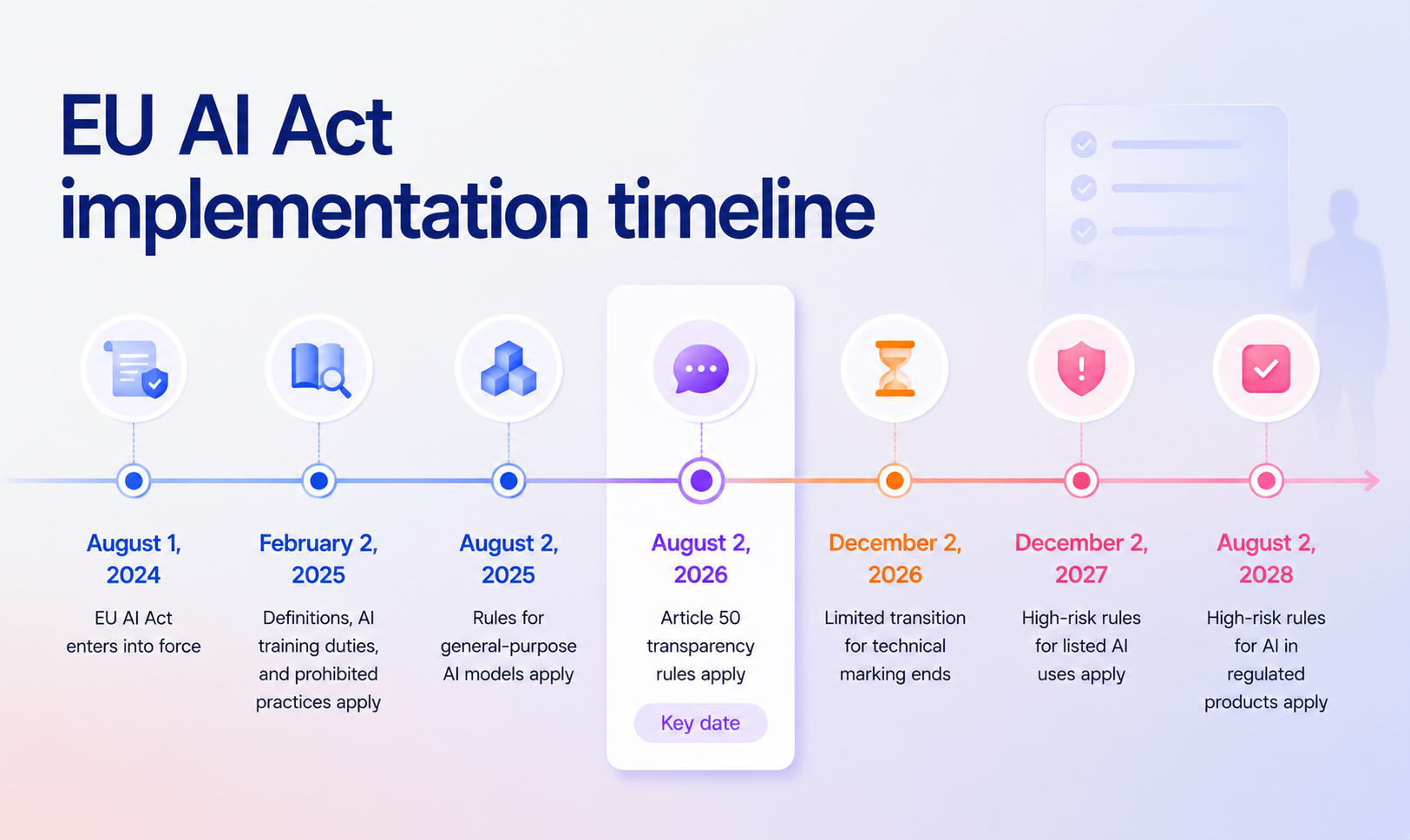
The official implementation timeline is the best place to check EU AI Act updates. The dates below follow the amended implementation schedule. Earlier summaries of the AI Act may show different dates for high-risk systems because they predate the Digital Omnibus amendments.
Date | What applies | Why it matters |
|---|---|---|
August 1, 2024 | The regulation entered into force | The phased transition began |
February 2, 2025 | Definitions, AI literacy duties, and prohibited practices began applying | Providers and deployers need to ensure an appropriate level of AI literacy among relevant staff |
August 2, 2025 | Rules for general-purpose AI models and regulatory oversight began applying | Providers of multi-purpose models gained specific duties |
August 2, 2026 | Most remaining provisions and Article 50 transparency rules began applying | Chatbots and generated-content workflows need a transparency check |
December 2, 2026 | New prohibitions and a limited Article 50(2) transition apply | Certain existing systems receive extra time to add technical marking to AI output |
December 2, 2027 | High-risk rules for listed uses apply | This includes certain uses in employment, education, essential services, and migration |
August 2, 2028 | High-risk rules for AI inside regulated products apply | This includes certain medical devices, machinery, and other regulated products |
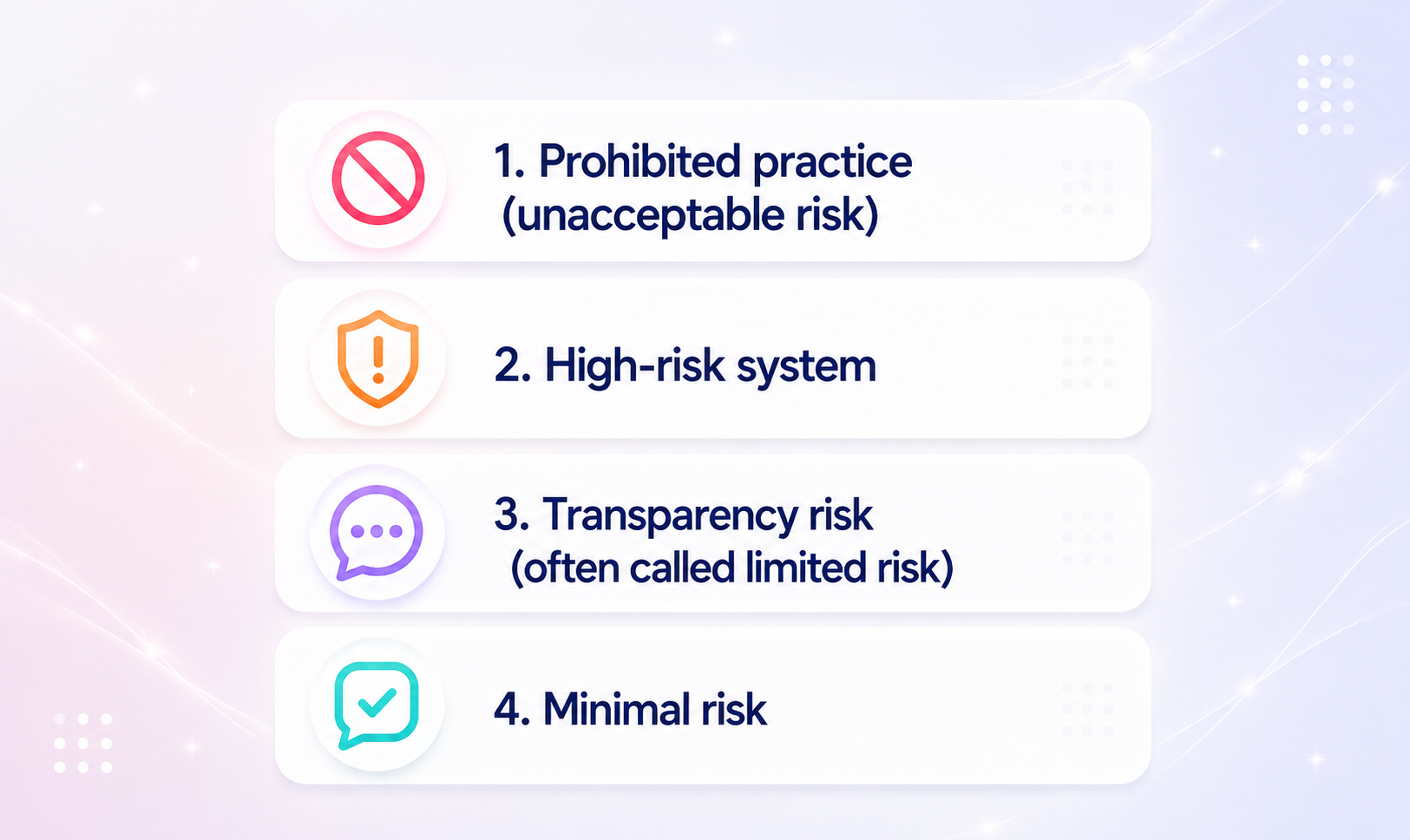
The Act aims to protect health, safety, and fundamental rights by matching its rules to the possible harm of an AI use. Some uses are prohibited, high-risk systems face detailed requirements, and certain chatbots or generated content require transparency. Most low-risk AI uses receive no additional system-specific duties under the Act, although other laws may still apply.
Category | Typical example from official EU guidance | Main consequence | Localization question |
|---|---|---|---|
Prohibited practice (unacceptable risk) | Social scoring or certain manipulative and biometric uses | The use is banned under the conditions defined in the Act | Is a language feature part of a prohibited use? |
High-risk system | AI used for certain employment, education, credit, migration, or safety-related tasks | Providers and deployers face detailed requirements for documentation, human oversight, accuracy, and monitoring | Does translated output influence a listed decision or regulated product function? |
Transparency risk (often called limited risk) | A chatbot or certain generated and manipulated content | Article 50 may require a technical mark, a disclosure to people, or both | Does a person interact directly with AI, and what content reaches people? |
Minimal risk | A spam filter or AI-enabled game in the Commission’s examples | The AI Act generally adds no mandatory system-specific duties, although other law still applies | Is the tool limited to low-consequence assistance, and do privacy, consumer, intellectual-property, or sector rules still apply? |
Machine translation is a function, not a risk category in the AI Act. There is no single rule that classifies every machine translation tool or translated text as high-risk, limited-risk, or minimal-risk. The classification depends on the system’s intended purpose and the function it performs. Using machine translation in recruitment, healthcare, lending, migration, or law enforcement calls for closer review, but the context alone does not make the translation system high-risk. The decisive question is whether the system is intended to perform or materially influence a high-risk function listed in the Act.
The localization-industry discussion in Episode 4 of LocReset, “The EU AI Act: Language AI Regulation and What It Means for Translation” makes the same distinction: translation, localization, voice-over, and dubbing are not assigned a fixed risk level. Their relevance depends on the system’s purpose and on where the resulting language is used.
Start with the purpose described by the provider and compare it with your actual use. Record the input, output, audience, later decisions, and likely effect of an error.
Providers generally control the system’s design, documentation, instructions for use, and technical features, while deployers control how staff use the system, which data enters it, and how its output is reviewed and published. Contracts can divide responsibilities, but they do not override the legal role created by how the system is actually used.
Vendor reviews should therefore cover the system’s purpose, limitations, supported languages, underlying models, product changes, and any Article 50 technical marking. They should also address where content is processed, who can access it, how long it is retained, whether it is used for training, and how it can be deleted.
It is also useful to maintain a simple inventory of AI-assisted localization use cases, including the owner, vendor, content type, languages, markets, publication channel, and review policy. This should be updated whenever the model, feature, audience, or purpose changes.
The EU AI Act transparency obligations apply to specific situations rather than every use of AI. EU AI Act Article 50 covers four main cases.
Providers of systems that talk directly with people must make the AI interaction clear, unless it is already obvious in context. Example: A bank’s customer-service chatbot tells the customer that it is an AI assistant when the conversation begins.
Providers of systems that generate audio, images, video, or text must add a machine-readable technical mark that allows the output to be detected as AI-generated, with specific exceptions. Example: An image-generation service adds machine-readable metadata to a campaign image, allowing compatible software to identify its AI origin.
Deployers of emotion-recognition systems or systems that group people using biometric data must inform the people exposed to them, with limited exceptions. Example: A shopping center using a permitted facial-analysis system to estimate visitor age groups displays a visible notice at its entrances.
Deployers must provide a visible or audible disclosure for deepfakes and a visible disclosure for certain AI-generated text about matters of public interest. Reviewed text can be exempt when a person or organization takes editorial responsibility for it. Example: A municipality publishing an AI-generated emergency notice without human review displays a visible AI-generated label with the notice.
These requirements should not be treated as one type of label. A technical mark helps software detect AI output and is generally added by the provider. A visible or audible disclosure informs the person exposed to the system or content and may be the deployer’s responsibility. When a disclosure to people is required, it must be clear, accessible, and provided by the first interaction or exposure.
A deepfake does not necessarily have to imitate a named person. Under the Commission’s three-part assessment for deepfakes, a fully synthetic presenter may fall within the definition when the depicted person could plausibly exist and the audience could mistake the presentation for authentic footage. An obviously fictional illustration or fantasy character will not necessarily meet that test.
The Commission’s Article 50 guidance distinguishes an automated translation tool from a conversational translation assistant. A tool that works in the background does not trigger the rule for direct AI conversations. An assistant that exchanges messages with a person may trigger it.
For Article 50(2), the final guidance lists AI-generated translations among the examples that may benefit from the exception for standard editing and minor alterations. The exception applies when the translation does not materially change the substance, meaning, style, or message. A feature that summarizes, rewrites, or creates new claims needs a separate assessment because it does more than translate.
Article 50(4) covers AI-generated text published to inform the public about matters such as politics, public services, public health, consumer safety, or major economic and scientific developments. The Commission’s Article 50 questions-and-answers page explains that a meaningful human review can remove the visible-disclosure duty when a person or organization also accepts editorial responsibility.
A translator’s review does not qualify automatically. The reviewer needs enough subject knowledge to check the meaning, not only spelling and fluency. A person or organization must also be responsible for the published text.
Publication timing is important too. Public-interest text published before August 2, 2026, does not require a retrospective visible disclosure. However, text generated before that date but first published on or after August 2 must meet the visible-disclosure requirement if Article 50(4) applies and the human-review exception is unavailable. This distinction matters for scheduled campaigns and prefilled content calendars.
For customers, Article 50(4) is the key provision for visible disclosure of AI-generated text. Interface strings, product pages, advertising, and documentation do not automatically require a visible label. Whether they do depends on the subject of the text, its purpose, and whether a qualified person has reviewed it and taken editorial responsibility.
For software vendors, Article 50(2) raises a separate issue around technical marking. A legal and product review should establish who qualifies as the provider of each AI system and whether a feature is limited to preserving meaning. Translation features may therefore require a different assessment from functions that rewrite, shorten, adapt, or generate content.
A content workflow could track whether content is human-written, machine-translated, AI-generated, or reviewed by a person, preserve this information during export, and flag unreviewed public-interest text. These records can support the legal assessment, but they do not determine the outcome on their own.
Treat disclosure as part of publishing. For each channel, name the owner, approve the wording in every language, and decide where and when the notice appears.
A clear English notice may become vague or too long in translation. Store approved wording in a glossary and test every version for layout and accessibility. Check that publishing does not remove a required technical mark.
The Commission offers optional EU icons for AI-generated content.
Using a particular icon is voluntary, while an applicable visible disclosure is mandatory. The icon does not replace a machine-readable technical mark where Article 50(2) applies, and using the icon alone does not establish compliance.
The EU AI Act Article 50 transparency requirements involve product, content, legal, engineering, and localization teams. One release owner should confirm the technical mark and visible disclosure before publication.
Article 99 of the EU AI Act sets maximum fines for Article 50 violations at €15 million or 3% of worldwide annual turnover from the previous financial year, whichever is higher for a company. For a qualifying small or medium-sized company, the lower amount is the ceiling.
These are maximums, not standard fines. Authorities consider how serious and long-lasting the violation was, how many people it affected, the company’s size, whether it cooperated, and whether the conduct was deliberate or careless. Warnings and other non-financial measures are also possible. National authorities handle most Article 50 enforcement.
AI enters localization in different ways: machine translation, review suggestions, terminology support, content generation, quality checks, and conversational assistants. Assess each function separately because it handles different content and produces different results.
Consider a public health authority that uses AI to draft vaccination guidance and translates it into eight languages. A medical editor checks the facts, language professionals review each translation, and the authority takes responsibility for publication. This process may support the Article 50(4) review exception and helps prevent an incorrect claim from spreading across markets.
Reviewers need the source, audience, and authority to reject output or pause publication. For sensitive material, assign separate responsibility for language, facts, and final approval. Terminology checks can find an unapproved safety term, translation memory can reuse approved wording, and style guidance can keep the voice consistent, but these controls do not decide legal compliance. A qualified person still determines whether the translation preserves the claim in context.
A translation can be grammatically correct and still fail to communicate what a person must know or do. This is especially important for consent notices, compliance disclosures, legal information, safety instructions, and public-service content. Reviewers need to check whether the target audience will understand the message in context, not only whether each sentence matches the source.
The LocReset discussion on the EU AI Act and translation highlights a recurring constraint for language teams: compliance text may arrive under time pressure and without enough background. Legal, Compliance, and Localization should agree on the intended meaning, audience, required terminology, and escalation route before translation begins. A subject expert should resolve questions that a language reviewer cannot answer from the source alone.
AI disclosures deserve the same control as other important language assets. Store approved versions by language and channel, name the owner, record the reviewer and approval date, and retain the version that was published. This audit trail helps an organization show which text, system, and decision process were used at a given time.
Our guides to AI localization workflows, AI language translators in localization management, and glossaries that constrain AI terminology explain how these controls operate in day-to-day language work.
The AI Act does not replace the GDPR requirements for organizations that process personal data, copyright law, confidentiality duties, or sector-specific rules. The Act itself preserves rights and safeguards under EU data-protection law, while the European Commission’s guidance for general-purpose AI providers includes copyright policies and summaries of training content among their obligations. A localization workflow therefore needs separate checks for the AI Act and for the content, data, and rights involved.
Roles must also be assessed separately under each law. An organization may be a deployer under the AI Act but a data controller under the GDPR when it determines why and how personal data is processed. According to the European Commission’s explanation of controllers and processors, an AI vendor may be a processor, a controller for its own processing purposes, or both in different parts of a service.
Voice cloning shows why this wider review matters. Creating or adapting a person’s voice can involve personal data, permission to use the recording, contractual rights, copyright or related rights, and national protections for a person’s identity. Before generating or localizing synthetic speech, confirm who owns or controls the source recording, what documented permission or legal basis covers the intended use, which markets and channels it covers, how long it remains valid, and what happens when that permission expires or is withdrawn. The LocReset episode uses voice work as one example of why localization decisions can carry privacy and rights consequences even when the language task itself is not high-risk under the AI Act.
A translation management system keeps source content, language resources, review status, and decisions in one workflow. It cannot provide a legal classification, but it can help teams apply an agreed policy consistently.
LingoHub supports AI translation with human review, translation memory, glossaries, style guidance, and collaboration among content producers, translators, reviewers, and product teams. Quality checks can flag missing translations, invalid placeholders, incomplete plural forms, and inconsistent terminology. These checks improve language and file quality but do not prove compliance with Article 50.
Review the workflow before rollout and after a material change.
Define the function: Separate translation, content generation, review support, quality checks, and direct conversations. Record what the provider says the system is designed to do.
Identify the roles: Note who provides the system, who uses it, who publishes the output, and who may be affected.
Map the content and data: Mark confidential, personal, regulated, copyrighted, and public-interest material. Record where it is processed, who can access it, how long it is kept, and whether it is used for training.
Check the legal category and transparency duties: Look for prohibited uses, high-risk uses, direct AI conversations, technical marking of generated content, deepfakes, and public-interest text. Where Article 50 applies, record whether a technical mark, a visible disclosure, or both are required and who is responsible.
Assign review and approval: Involve Legal, Compliance, and Localization early for regulated content and disclosures. Decide who checks the language, who checks the facts, and who approves publication. Give reviewers the source and enough context to reject or escalate unsuitable output.
Keep evidence and review changes: Save the assessment, vendor documents, approvals, exceptions, and incidents. Reassess the workflow after a new model, feature, language, audience, or purpose.
Try LingoHub for free or book a demo.
No. Using translation in employment, migration, healthcare, or another sensitive field does not by itself make the translation system high-risk. Classification depends on the system’s intended purpose and whether it performs or materially influences a high-risk function listed in the Act.
No. Article 50 distinguishes a visible disclosure to people from a machine-readable technical mark. The visible-disclosure duty under Article 50(4) concerns AI-generated text published to inform the public about a matter of public interest and does not apply when the required human review and editorial responsibility are present. Translation that preserves the original meaning may also qualify for an exception from the separate Article 50(2) technical-marking rule.
Keep the record of provider and deployer roles, vendor documents, data flows, review policy, approved terminology, notices, test results, approvals, incidents, and change history. Link each record to the relevant system version and publication channel.
A weak localization workflow can create more than a quality issue. When multilingual text carries a required disclosure, safety instruction, consent request, or regulated claim, unclear wording or missing review can contribute to compliance exposure. A structured workflow makes AI decisions visible across languages and keeps human review connected to the text that customers and the public receive.

AI localization: Supercharge your translation workflow
AI localization uses artificial intelligence to streamline translation workflows, improve quality, and scale global content faster. Learn more in our blog.

AI localization insights from the Nimdzi 100 2026 report
Explore the key findings from the 2026 Nimdzi 100 report, including AI localization, automation, human review, and the future of enterprise localization.
From SMT to LLMs: How AI language translators have evolved
Discover how AI language translators transform global communication, remove language barriers, and support seamless cross-cultural connections in real time.
