Skip to content

LingoHub vs Weblate

Picking a Weblate alternative comes down to two questions: who runs the platform, and who pays for the AI. On LingoHub, we run the platform for you in the EU, and AI credits for LINA, the AI inside LingoHub come with your plan, along with every integration we offer. Open-source projects and non-profits can use LingoHub for free on request.

4.6

Star icon

User rating

4.6

Star icon

User rating

4.5

Star icon

User rating

2026

Best customer support

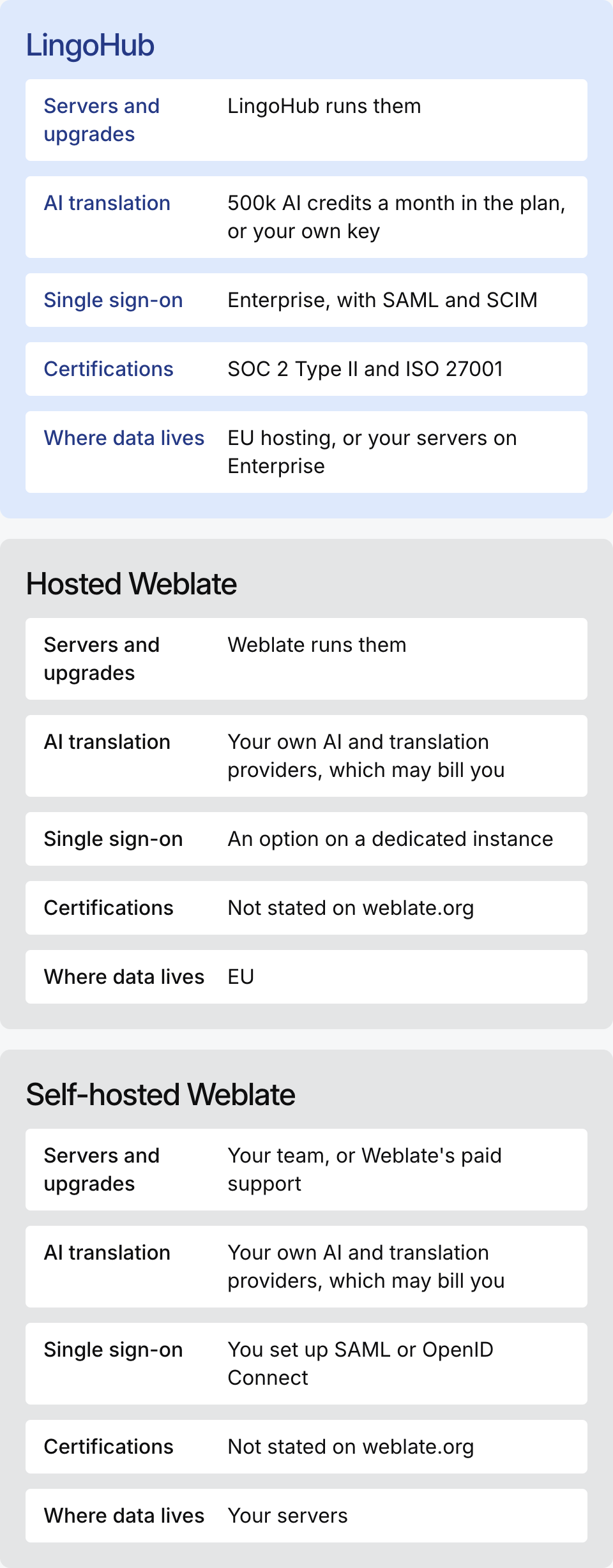
What does each setup leave your team to handle?

We run LingoHub's servers and upgrades under SOC 2 Type II and ISO 27001. Hosted Weblate runs the servers for you too. Self-hosted Weblate is free under the GPLv3+ license and asks for your team's time instead: deployment, maintenance, upgrades and troubleshooting, with Weblate's paid support if you want help.

Book a 30-minute localization review
What each setup leaves your team to handle. LingoHub: LingoHub runs the servers and upgrades; AI translation uses 500k AI credits a month in the plan, or your own key; single sign-on on Enterprise, with SAML and SCIM; SOC 2 Type II and ISO 27001; EU hosting, or your servers on Enterprise. Hosted Weblate: Weblate runs the servers; your own AI and translation providers, which may bill you; single sign-on as an option on a dedicated instance; certifications not stated on weblate.org; data in the EU. Self-hosted Weblate: your team, or Weblate's paid support, runs the servers and upgrades; your own AI and translation providers; you set up SAML or OpenID Connect; certifications not stated on weblate.org; your servers.

How does Hosted Weblate's price grow as you add languages?

Hosted Weblate charges by hosted strings, and the source language counts too: source strings × (target languages + 1). If you connect machine translation or AI providers, they may bill you separately. On LingoHub, adding a target language doesn't change the price: its translations count toward the hosted characters in your plan.

LingoHub Platform

Platform is a single plan at €249 a month, or €209 a month billed yearly (€2,508 a year). It includes 5 million hosted characters and 500k AI credits a month for LINA.

Hosted Weblate at 6 languages

Across 2,000+ LingoHub projects, the median project translates into 6 target languages. An app with 2,000 source strings at that median comes to 14,000 hosted strings, which is Weblate's 40k plan at €70 a month.

Hosted Weblate at 20 languages

The same app in 20 target languages comes to 42,000 hosted strings, which moves it up to the 160k plan at €114 a month.

How do strings move between your repository and translators?

LingoHub syncs with your branches

LingoHub pulls new source strings from GitHub, GitLab, Bitbucket, Azure DevOps or AWS CodeCommit on every commit or on a schedule. Translations go back as a pull request (a merge request on GitLab) or a direct commit. One project can follow several branches, with progress for each, and the same workspace connects Figma, Storyblok, Contentful, HubSpot, Zendesk and Crisp for content that never touches the repository.

LINA works per target language

You give LINA a role for each target language. As Translator, it translates with your glossary, translation memory and style guide, and a team member approves. As Agent, it also checks and approves, and your team handles only the segments it marks Blocked.

Weblate commits from its own clone

Weblate keeps its own copy of your repository, pulls changes, commits translations and pushes them back. It has app and webhook integrations for GitHub, GitLab, Bitbucket, Azure Repos, Gitea, Forgejo, Gitee and Pagure. Machine translation and LLM output can be saved as suggestions, drafts or translations, and an optional LLM evaluation flags issues for reviewers.

How do LingoHub and Weblate compare, row by row?

Weblate
Price

Platform: €249 a month, or €209 a month billed yearly

Hosted: €47 to €616 a month, or €470 to €6,160 a year. Self-hosted: free

Users and projects

Unlimited

Unlimited

Over-the-air updates

CDN delivery and iOS and Android SDKs

JavaScript localization CDN, translation files CDN and Kotlin SDK CDN add-ons

Free for open source

Free for open-source projects and non-profits, on request

Libre plan: free for public projects, up to 160k hosted strings

Free trial

14 days, no credit card

14 days on hosted plans

Prices and plans as of November 8, 2026. All prices exclude VAT. LingoHub also bills in US dollars: $249 a month billed yearly, or $299 billed monthly.


Disclaimer:


All product names, logos, brands, and trademarks are the property of their respective owners. They are used on this page for identification and comparison purposes only. All the information on this page is published just for an acquaintance without the intention to endorse the LingoHub app to any third parties and without any guarantees.

The information on this page is provided from publicly available sources and is valid as of 08.11.2026. LingoHub is not responsible for changing data on the sources and warns that the actual data can differ. To report issues, contact us at info@lingohub.com.

Where do Tolgee, Pontoon and the hosted platforms fit?

Open-source tools you host yourself

Like Weblate, Tolgee, Mozilla's Pontoon and Traduora are open-source localization platforms you can run on your own servers.

Hosted TMS platforms

Crowdin, Lokalise, Phrase, Transifex, Localazy, Smartling and Smartcat are hosted TMS platforms, like LingoHub. Our comparisons page puts LingoHub side by side with Tolgee and most of them.

Moving from Weblate?

On a yearly Platform plan or Enterprise, we migrate your projects, translation memories and glossaries.

FAQ about LingoHub and Weblate

Questions teams ask when they move from Weblate.

Can I run LingoHub on my own servers?

Expand FAQ-entry Icon

Yes, on LingoHub Enterprise, on request. Enterprise also adds custom roles and a custom LLM. It’s priced on a yearly contract, and you’ll get a written proposal within a week.

Is there a Weblate alternative for Android apps?

Expand FAQ-entry Icon

Yes. LingoHub syncs your Android string files from your repository and can deliver translation updates over the air with its open-source Android SDK, which supports API 24 and up and both XML and Compose.

Does LingoHub check placeholders and ICU syntax the way Weblate does?

Expand FAQ-entry Icon

Yes, on every plan. Before a file leaves LingoHub, quality checks catch missing or changed placeholders, ICU syntax errors, tags and length limits. For LINA, you also pick checks for glossary terms, spacing, punctuation, and date, time and number formats in the target locale. In the Agent role, LINA retries a segment that fails a check up to 3 times before it marks it Blocked.