Localization workflows & operations
TMS pricing: what 12 platforms cost for the same team
Localization workflows & operations
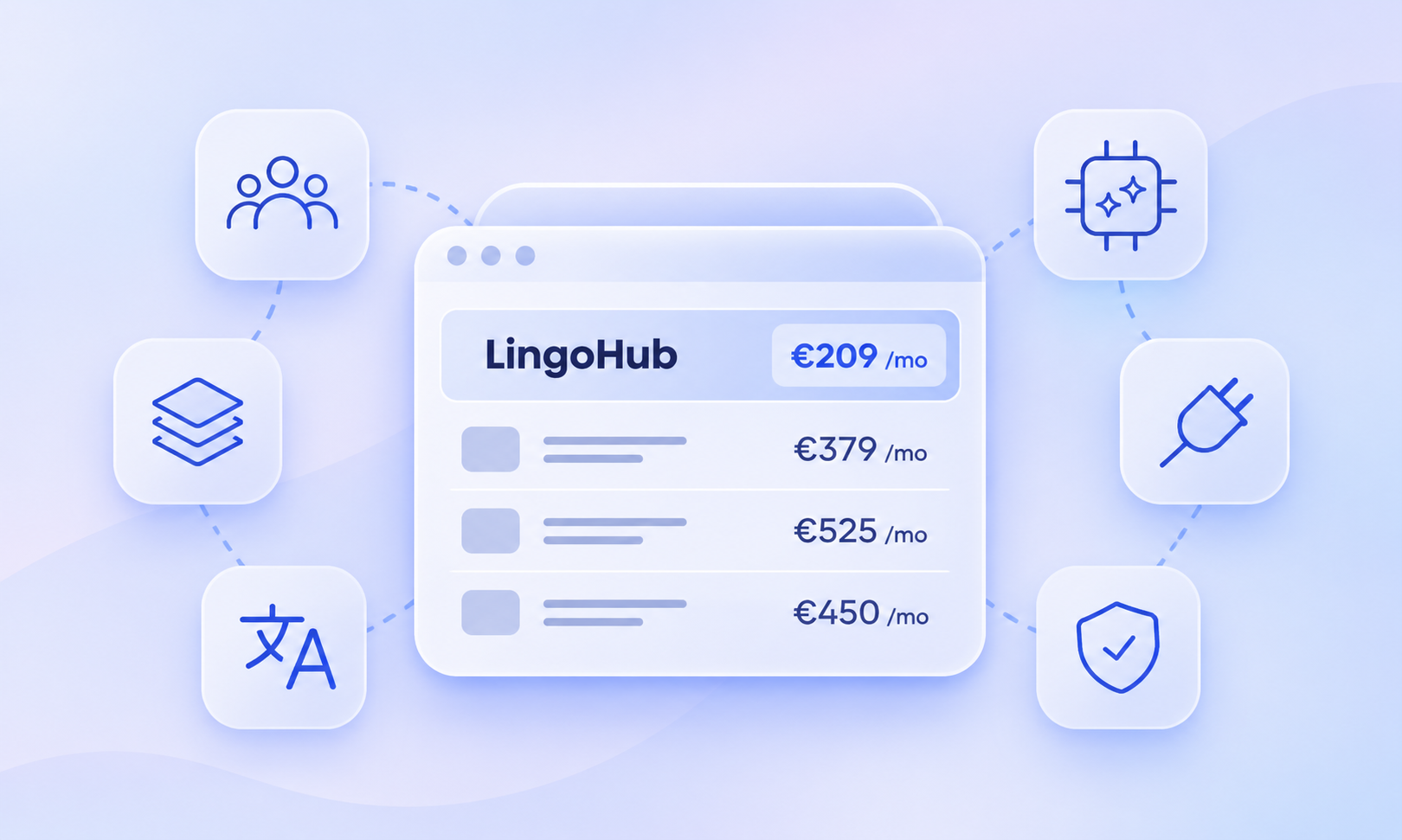
Table of content

You’ve found a translation management system that looks like a good fit. It supports your languages, connects to your development tools, and promises to make localization easier.
Then you open the pricing page.
One platform charges per seat. Another counts every word you store, including its translations. A third offers unlimited users but charges separately for AI translation. And some won’t tell you the price until you’ve spoken to their sales team.
Suddenly, comparing translation management systems isn’t as simple as comparing monthly subscriptions.
So, what would these platforms actually cost the same team?
We decided to find out. We checked the public pricing pages of 12 translation management systems using one example: a SaaS company with 12 team members, an app available in 8 languages, and a steady flow of new content to translate.
The results were surprisingly far apart. Eight platforms published enough information to identify a suitable plan, with annual prices ranging from €1,140 to $60,000. Three required a quote, while one didn’t publish enough usage limits to determine the right plan.
Here’s what we found, where additional costs can appear, and what to look for before choosing a platform.
Imagine your team has just hired two new translators. You’re also preparing to launch your app in three additional languages.
Will your translation management system become more expensive?
That depends entirely on how your provider calculates its pricing. Most TMS platforms charge based on a combination of five factors:
Seats: Some platforms limit how many people can manage, translate, or review content. Others include unlimited users.
Stored content: Your subscription may depend on the number of words, strings, or characters stored in the platform. Some providers count each translation separately, meaning more languages also mean more stored content.
Source keys: Instead of counting every translation, platforms like Localazy charge based on the number of keys in your source language.
AI and machine translation: Many plans include a certain number of AI credits or translated words. Once you reach that limit, additional usage costs extra.
Feature availability: Integrations, single sign-on (SSO), and additional workspaces may only be available on higher-priced plans.
Most platforms combine two or three of these factors.
That’s why a plan advertised as “from $149/month” doesn’t necessarily tell you what your team will actually pay.
To make the comparison fair, we used the same fictional SaaS company for every platform.
The company has a growing international customer base, a product team that regularly releases new features, and translators working across eight target languages.
Here’s what its localization setup looks like:
50,000 source words, or approximately 5,000 translation keys (assuming 10 words per string)
8 target languages for its application
12 team members: 4 developers and managers, plus 8 translators
GitHub and Figma integrations to connect development and design workflows
5,000 new source words per month, resulting in approximately 40,000 AI-translated words across all languages
We then checked which plans could accommodate this workload and where additional charges might apply.
Platform | Plan for this team | Price, billed yearly | What could increase the cost |
|---|---|---|---|
LingoHub | Platform | $249/month (€209), plus one €6 AI credit add-on | Additional AI credits beyond 500,000/month (~37,500 words) cost €6 per 100,000 credits. Hosted characters beyond 5 million cost €10 per additional million. Seats, projects, and integrations are unlimited. |
Lokalise | Growth | $379/month | Explorer includes 240,000 AI/MT words annually, while this team needs 480,000. Growth includes 10 advanced seats and 3 integrations. |
Phrase | Software UI/UX | $525/month | Includes 15 Strings seats, 1 million managed words, and 1 million MT units annually. The public pricing page doesn’t specify how many words an MT unit represents. Additional usage requires contacting sales. |
Crowdin | Team | $450 or €423/month ($5,400/year) | Includes 500,000 hosted words. Since each target language counts separately, this team uses 400,000. Provider prices are due for AI and MT usage. |
Localazy | Business | $175/month ($2,100/year) | Includes 10,000 source keys and 68,000 AI words. Additional AI translation costs approximately $0.005 per word on average. |
Weblate (hosted) | 160k plan | €1,140/year | Hosted strings include source and target languages, resulting in 45,000 strings for this team. External translation and AI providers may charge separately. |
POEditor | Enterprise | $221/month | Counts source terms and translations, resulting in 45,000 strings. The Premium plan’s 30,000-string limit is insufficient. No AI allowance is listed. |
XTM Cloud | Business | $60,000/year | The Team plan doesn’t list an AI word allowance. Business includes 600,000 AI words annually. Additional words are priced separately by XTM. |
Tolgee | Cannot be determined | From €58 to €373/month | Counts each language separately, resulting in 450,000 hosted words. The pricing page doesn’t publish the word limits for individual tiers. |
Transifex | Custom quote | Not published | Pricing depends on AI-translated words. Seats, projects, and connectors are included. |
Smartling | Custom quote | Determined by Smartling | Translation services start at $0.0075 per word for MT and $0.20 per word for human translation. |
Smartcat | Custom quote | Not published | GitHub integration requires the Anticipate plan, which is priced on request. Adapt starts at $1,200 annually but includes a more limited selection of integrations. |
Disclaimer: This comparison is based on publicly available pricing information accessed on November 16, 2026. Prices are shown in the currencies published by each provider. Plans, features, usage limits, and additional charges may change at any time. Actual costs can also depend on negotiated contracts, taxes, exchange rates, and individual requirements.
Your app is doing well internationally, and the product team wants to expand into seven new markets.
Great news for the business. But what does that mean for your localization budget?
Let’s take our example company from 8 to 15 target languages, without changing the amount of source content.
The difference between pricing models becomes much clearer:
LingoHub: The company now stores approximately 800,000 words across its source and translations. Based on LingoHub’s estimate of around 1 million words per 5 million characters, that’s roughly 4 million hosted characters. The team stays within its existing plan.
Crowdin: Hosted words increase to 750,000, exceeding the Team plan’s 500,000-word allowance. The company needs additional capacity or a move to the quote-based Business plan.
Tolgee: Hosted words increase to 800,000. Depending on the applicable limits, the account may automatically move to a higher tier.
Weblate and POEditor: Both now count approximately 80,000 strings, which still fit within the selected plans.
Localazy: The company still has 5,000 source keys. Adding target languages doesn’t change that number, so the base plan stays the same.
Lokalise: Growth includes unlimited languages, so the number of target languages doesn’t trigger a plan change.
Even if your subscription stays the same, translating more languages means processing more content.
With 15 target languages, our example team now translates approximately 75,000 new words every month, compared with 40,000 before.
On LingoHub, that translates to roughly 1 million AI credits at the assumed usage rate. The additional AI credit cost increases to around €30 per month. Lokalise Growth, meanwhile, includes unlimited standard AI/MT words.
For another perspective, here’s what translating an additional 1,000 words costs according to the providers’ published estimates:
Platform | Estimated cost per 1,000 words |
|---|---|
LingoHub | €0.80 |
Localazy | $5.00 |
Smartling (machine translation) | From $7.50 |
These estimates aren’t directly interchangeable, since providers use different translation engines, credit systems, and billing rules. However, they illustrate why it’s worth checking translation usage costs alongside subscription prices.
Adding languages is only one part of scaling a localization workflow.
Maybe your company hires another developer. Your marketing team wants to manage website translations, too. And customer support needs to connect its help center.
Now you have more people and more tools involved in localization.
Some platforms accommodate that growth within your existing subscription. Others introduce additional limits.
For our example team:
LingoHub includes unlimited seats, projects, and integrations in its Platform plan. Adding a 13th teammate or connecting another supported tool doesn’t increase the subscription price.
Lokalise Growth includes 10 advanced seats and 3 integrations.
Crowdin Team includes 5 manager seats.
Phrase Software UI/UX includes 15 Strings seats.
Smartcat requires the Anticipate plan for GitHub integration.
This is particularly relevant when localization expands beyond developers and translators.
Product managers, designers, marketers, and customer support teams may all need access to translated content. A pricing model that works for a small engineering team might become less attractive when more departments get involved.
For smaller teams, the monthly subscription is often the first thing people compare.
For larger organizations, however, the real question is different: How predictable will our localization costs be as we grow?
An enterprise team might manage dozens of languages, several products, and millions of words of content. At that scale, additional usage costs and plan restrictions can matter more than the starting subscription.
Two things are particularly worth checking.
Imagine you’re launching a major product update and suddenly need to translate twice as much content as usual.
Will you know what that costs before starting?
LingoHub publishes its AI credit and hosted character add-on prices. Localazy provides an average AI translation price, while Smartling publishes starting rates for translation services.
Other providers, including Transifex, XTM Cloud, Phrase, Crowdin, and Smartcat, don’t publish all the prices needed to calculate additional usage costs in advance.
For companies with fluctuating translation volumes, transparent usage pricing can make budgeting much easier.
As more teams work with localization content, security requirements often become more important.
Single sign-on (SSO), for example, may only be available on certain plans.
According to the published pricing information, SSO is available with:
LingoHub Enterprise
Lokalise Enterprise
Crowdin Business
Phrase Business
Localazy Enterprise
Smartcat Anticipate
Transifex
LingoHub also offers an Enterprise plan with custom annual pricing. Businesses can request a written proposal within one week.
You don’t need to build a complicated spreadsheet to start comparing platforms.
But before opening another pricing page, it’s worth gathering a few details about your current localization workflow.
Start with these five questions:
How many languages do you support? Include the languages you’re planning to add next year.
How much content do you manage? Check your source words, translation keys, or stored characters.
Who needs access? Count everyone who translates, reviews, manages, or works with localized content.
How much do you translate each month? Include the volume you expect to process with AI or machine translation.
Which tools need to connect? Think about development repositories, design tools, CMS platforms, and support systems.
Once you have these numbers, compare each provider using the same workload.
And don’t forget to ask what happens when you exceed a limit. Sometimes the difference between two plans isn’t the starting price, but how much the next 100,000 words, new language, or additional team member will cost.
If you’re currently using Phrase Strings, Lokalise, Crowdin, or Localazy, you can use the calculator on our pricing page to compare your current setup with LingoHub.
For a broader look at platform selection, long-term costs, and migration considerations, read our guide on how to choose a translation management system.
That depends on the type of software and how you use it.
A translation management system typically charges a subscription based on factors such as team size, stored content, and translation volume. Some plans start below $100 per month, while enterprise solutions can cost thousands.
Machine translation engines, on the other hand, often charge directly for usage. For example, Amazon Translate costs $15 per million characters.
Yes. Several translation management systems offer free plans, usually with limits on users, content, or features.
Examples include:
LingoHub: Free for eligible non-profit organizations and open-source projects upon request. Other teams can start with a 14-day free trial without a credit card.
Crowdin: Free plan with 40,000 hosted words.
Localazy: Free plan with 200 source keys.
Tolgee: Free plan with 30,000 words and 3 seats.
POEditor: Free plan with 1,000 strings.
Weblate: Libre plan for public projects.
Smartling: Core plan is free to start.
Free plans can be useful for smaller projects or testing a platform before committing to a paid subscription.
Phrase offers a 14-day free trial. Its lowest-priced Freelancer plan starts at $27 per month when billed annually.
Every localization setup is different. The number of languages, your translation volume, and the tools you use all influence which platform offers the best fit.
With LingoHub, you get unlimited seats, projects, and integrations, along with transparent pricing for additional AI credits and hosted content.
Start your free 14-day trial or book a demo to see how LingoHub fits your workflow.

How to choose a translation management system: A buyer’s checklist
Use this practical checklist to evaluate translation management systems by integrations, AI, security, workflows, pricing, support, and scalability.

5 best translation management systems for software in 2026
Compare the 5 best translation management systems for software localization in 2026, including LingoHub, Phrase, Lokalise, Crowdin, and Transifex.

How to migrate translations and glossaries to a new TMS
Move resource files, glossaries and translation memory to a new TMS in 9 steps: inventory, export, language mapping, import, validation and cutover.
