NLP vs LLM: Key differences and examples
AI translation
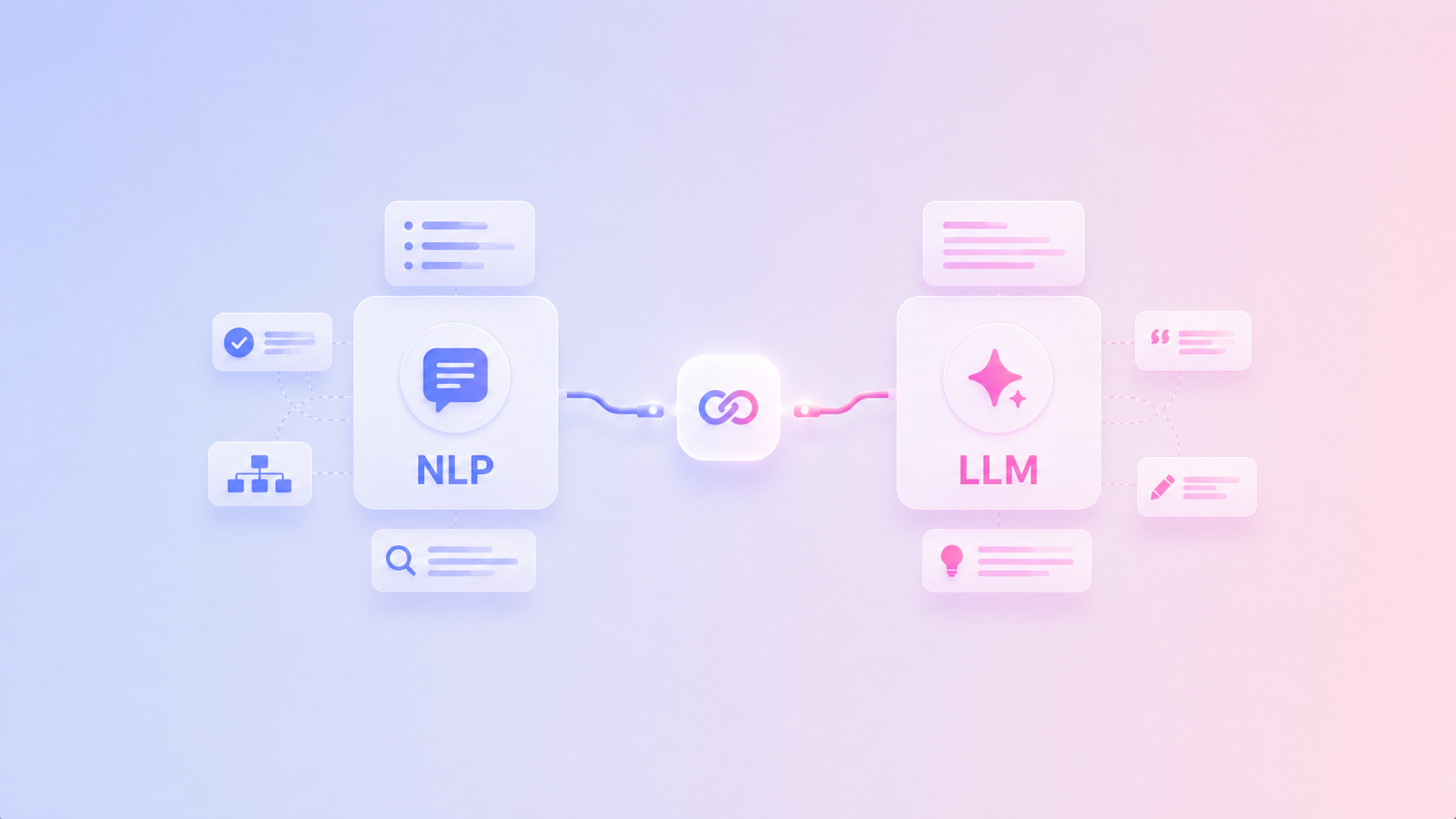
Table of content

Natural Language Processing (NLP) and Large Language Models (LLMs) are often used as if they mean the same thing. They do not.
NLP is the broader field, the science of teaching machines to process and understand human language. IBM defines NLP as a subfield of computer science and artificial intelligence focused on enabling computers to understand and communicate with human language.
An LLM, or large language model, is a specific type of language model trained on large amounts of data. Google Cloud describes an LLM as a statistical language model trained on massive data that can generate and translate text, create other content, and perform NLP tasks.
Think of NLP as the discipline and LLMs as one of its most powerful instruments. Before transformer-based language models became practical, NLP systems were typically designed for individual tasks. One model classified sentiment, another detected entities, another translated text. Modern LLMs changed this by performing many language tasks within a single model using natural-language instructions. This explains why LLMs have become central to today’s AI applications, they simplify workflows that previously required multiple specialized systems.
This guide explains how they connect, where they differ, and what the distinction means for AI, content, and localization.
NLP is the broader field of AI focused on understanding and processing human language.
LLMs are one type of NLP model built on transformer architectures and trained on massive datasets.
Use traditional NLP for deterministic tasks like language detection, placeholder validation, and terminology enforcement.
Use LLMs for tasks that require generation, summarization, rewriting, translation, or contextual reasoning.
In enterprise localization, the best workflows combine both approaches.
To understand what is NLP vs LLM vs generative AI, separate the field, the model type, and the output category, like in the table below.
Concept | Meaning | Example |
|---|---|---|
NLP | Field of AI focused on human language | Detecting sentiment in customer feedback |
LLM | Large model trained on language data | Translating, summarizing, or rewriting content |
Generative AI | AI that creates new content | Writing text, generating images, or producing code |
According to IBM, NLP is the language-focused discipline. LLMs are models that can perform many NLP tasks. Generative AI is broader: it includes systems that create text, images, audio, video, software code, and other content. IBM defines generative AI as AI that creates original content in response to a prompt or request.
For marketing, localization, and product teams, this distinction keeps AI conversations more precise. A chatbot, terminology checker, translation assistant, and sentiment classifier may all use language AI, but they do not need the same setup, cost profile, or review process.
Traditional NLP systems are often built for specific tasks. They classify text, extract entities, detect intent, identify language, tag grammar, or analyze sentiment. Some use rules, some use statistical models, and many use machine learning.
LLMs can handle many tasks through natural-language instructions. Instead of building a separate pipeline for every language task, teams can often prompt or configure an LLM to summarize, classify, rewrite, translate, extract information, or answer questions.
Dimension | NLP | LLM |
|---|---|---|
Scope | Broad field of language AI | Specific model family |
Typical setup | Task-specific pipeline or model | General-purpose model guided by prompts, context, or fine-tuning |
Strength | Control, efficiency, predictable task handling | Flexibility, generation, broad task coverage |
Common output | Labels, extracted data, structured results | Text, summaries, translations, answers, classifications |
Common risk(s) | Too rigid when language varies | Hallucinations, cost, privacy, inconsistent output |
A traditional NLP system may classify support messages into “billing,” “technical issue,” or “feature request.” An LLM can classify the same messages, summarize the customer’s problem, draft a reply, and suggest whether the case needs human review.
Most modern LLMs are based on transformer architectures, introduced in the paper “Attention Is All You Need”. Models such as GPT, Gemini, Claude, and Llama all belong to this family. While users don’t need to understand transformer internals to use them, knowing that LLMs are one implementation within the broader NLP field helps explain why the two terms are not interchangeable.
LLMs are commonly understood as part of the NLP landscape because they process and generate human language. They have changed how many NLP tasks are implemented, but they have not replaced the broader field. NLP also includes methods that do not rely on LLMs. A language detection tool, a rule-based placeholder check, or a deterministic terminology validation step may belong to an NLP workflow without using a large model.
This distinction matters in enterprise software because bigger is not always better. Some tasks need creativity and nuance. Others need strict consistency, low cost, fast processing, or predictable behavior.
NLP models can be rule-based, statistical, machine-learning-based, deep-learning-based, or transformer-based. LLMs are one type of NLP model family, usually trained on very large datasets and designed to handle many language tasks. Google also describes LLMs as systems that can be adapted through techniques such as prompt tuning for different use cases.
Localization teams are advised to combine several approaches. A glossary check may use rules. Translation memory may reuse approved translations. An LLM may generate a first translation or suggest better phrasing. Automated QA can then check placeholders, formatting, character limits, and terminology.
LingoHub follows this practical mix: translation memory, glossary, style guides, context, AI translation, review, and QA all support different parts of the localization workflow.
LINA, LingoHub’s AI-powered linguistic agent, works with the context available in the workflow, including glossary, style guide, translation memory, project context, and existing translations.
Traditional NLP is often the better fit when the task is narrow, repeatable, and needs predictable output.
Examples include language detection, metadata extraction, duplicate detection, placeholder validation, spell checks, keyword matching, basic sentiment classification, or terminology enforcement. These tasks benefit from consistency and clear rules.
A localization example makes this clear: checking whether {user_name} appears in both the source and translation does not require an LLM. A deterministic QA rule is safer and more efficient.
LLMs are flexible, but flexibility comes with trade-offs. They typically require more computing resources, can generate inconsistent output, and may hallucinate information when context is incomplete. For tasks, such as checking placeholders, validating HTML tags, or enforcing approved terminology, a rule-based NLP system is often faster, cheaper, and more reliable.
The best enterprise workflows therefore combine NLP where correctness is critical with LLMs where language quality and reasoning provide additional value.
LLMs are often the better fit when the task requires language generation, rewriting, summarization, contextual reasoning, or flexible interpretation.
They are useful when a system needs to handle open-ended text rather than fixed categories. This makes them valuable for drafting translations, adapting tone, summarizing long content, generating variants, explaining context, or helping reviewers evaluate whether a message feels natural.
A translation example shows the value. The English word “support” can mean customer service, technical assistance, emotional help, or physical support. An LLM with the right localization context can choose a better translation than a generic word-by-word system.
Many strong language AI workflows use NLP and LLMs together.
Workflow step | Primary technology |
|---|---|
Detect source language | NLP |
Validate placeholders and tags | Rule-based NLP |
Retrieve glossary and translation memory | Localization platform |
Generate translation draft | LLM |
Check terminology and formatting | NLP |
Review tone and fluency | LLM + Human |
Final approval | Human reviewer |
The LLM may create, summarize, translate, or suggest. NLP style checks may validate whether the output follows rules. Human reviewers can then focus on nuance, tone, brand fit, and market sensitivity.
For localization, this mixed approach is often more practical than choosing one method for everything. A campaign headline may benefit from LLM suggestions. A placeholder check should stay strict. A glossary rule should be enforced consistently. A final brand-sensitive review may need a human.
The difference between NLP and LLMs becomes easier to see in everyday business workflows. NLP is often used to classify, extract, detect, or validate language. LLMs can go further into explanation, generation, rewriting, and context-aware suggestions.
Sentiment analysis: NLP may classify feedback as positive, neutral, or negative. An LLM can explain why a customer sounds frustrated and summarize the issue.
Translation: Traditional NLP or machine translation can produce a direct translation. An LLM can work with glossary, style, tone, and context to suggest wording that feels more natural.
Example: A rule-based check verifies that the placeholder {user_name} appears in both the source and translated text. The LLM then rewrites the surrounding sentence so it sounds natural in German while preserving the placeholder and approved terminology.
Search: NLP may match keywords or entities. An LLM can interpret intent and help retrieve semantically related content.
Customer support: NLP may detect intent and route a ticket. An LLM can summarize the case, draft a reply, and suggest next steps.
Localization QA: NLP-style checks can validate placeholders, links, tags, and length. LLMs can help review whether the translation preserves meaning and brand voice.
Example: An automated QA rule flags that the approved glossary term “Workspace” was translated incorrectly. The LLM suggests a revised sentence that keeps the approved terminology while improving readability, and the reviewer decides whether to accept the change.
NLP and LLMs are closely connected, so the confusion around them is understandable. The risk is that teams either overuse LLMs where simpler methods would work better, or trust fluent AI output without enough context, review, and quality control.
LLMs do not replace NLP: LLMs are part of the modern NLP toolkit, but many language tasks still benefit from smaller, more controlled methods. Placeholder checks, terminology validation, and language detection often need consistency more than generation.
Fluent output is not automatically correct: A response can sound polished and still contain terminology errors, unsupported claims, missing context, or inconsistent tone. NIST’s Generative AI Profile highlights risks specific to generative AI systems and frames them as risks that need to be managed across the AI lifecycle.
Not every AI workflow needs the same review level: A help center update, legal notice, pricing message, product UI label, and brand campaign should not follow the same approval path. The level of human review should match the content’s risk and visibility.
Generic AI tools do not understand brand voice by default: They need context, such as glossary, style guide, translation memory, screenshots, product information, audience, market, and content type.
Governance still matters: Responsible AI research shows why review and evaluation remain important. Stanford’s 2025 AI Index notes that standardized responsible AI evaluation for LLMs remains limited, while AI incident reports continue to increase.
Use NLP-style automation for checks that should behave the same way every time: placeholders, tags, links, length limits, language detection, and terminology validation. Use LLMs for tasks that benefit from context and natural language generation: translation drafts, tone adaptation, summaries, variants, and review suggestions. Keep human review for content where brand voice, legal sensitivity, cultural nuance, or customer trust is involved.
LingoHub brings these layers into one localization workflow. Teams can manage translation files, CMS content, glossaries, style guides, translation memory, AI assistance, review, and QA in one place. This becomes especially valuable in continuous localization environments where content changes every day.
Traditional localization often happens shortly before release. Continuous localization moves translation closer to development by automatically detecting new content, assigning work, running QA, and publishing updates as content changes.
LINA supports translation and review using the context already available in the workflow, including glossary, style guide, translation memory, project context, and existing translations. Teams decide how much autonomy fits each content type, market, and level of risk.
NLP and LLMs are easiest to understand when they are connected to real work. In localization, NLP helps keep the rules intact. LLMs ensure language sound more natural. Human review preserves meaning, tone, and trust.
Start your free trial or book a demo to see how LingoHub supports AI-assisted translation, review, and quality control.
NLP is the broader field of AI focused on human language. An LLM is a large language model that can perform many NLP tasks, including summarization, translation, classification, rewriting, and question answering.
NLP is the field focused on language. LLMs are large models that can perform language tasks. Generative AI is the broader category of AI that creates new content, including text, images, audio, video, and code.
LLMs are better for flexible language generation, summarization, rewriting, and context-sensitive tasks. Traditional NLP can be better for strict rules, structured classification, lower-cost processing, and predictable outputs.
NLP can support language detection, terminology checks, placeholder validation, and QA. LLMs can support translation, review, tone adaptation, summaries, and variant suggestions. In a localization workflow, both can work together with glossary, style guide, translation memory, and human review.
AI localization: Supercharge your translation workflow
AI localization uses artificial intelligence to streamline translation workflows, improve quality, and scale global content faster. Learn more in our blog.
AI localization insights from the Nimdzi 100 2026 report
Explore the key findings from the 2026 Nimdzi 100 report, including AI localization, automation, human review, and the future of enterprise localization.
From SMT to LLMs: How AI language translators have evolved
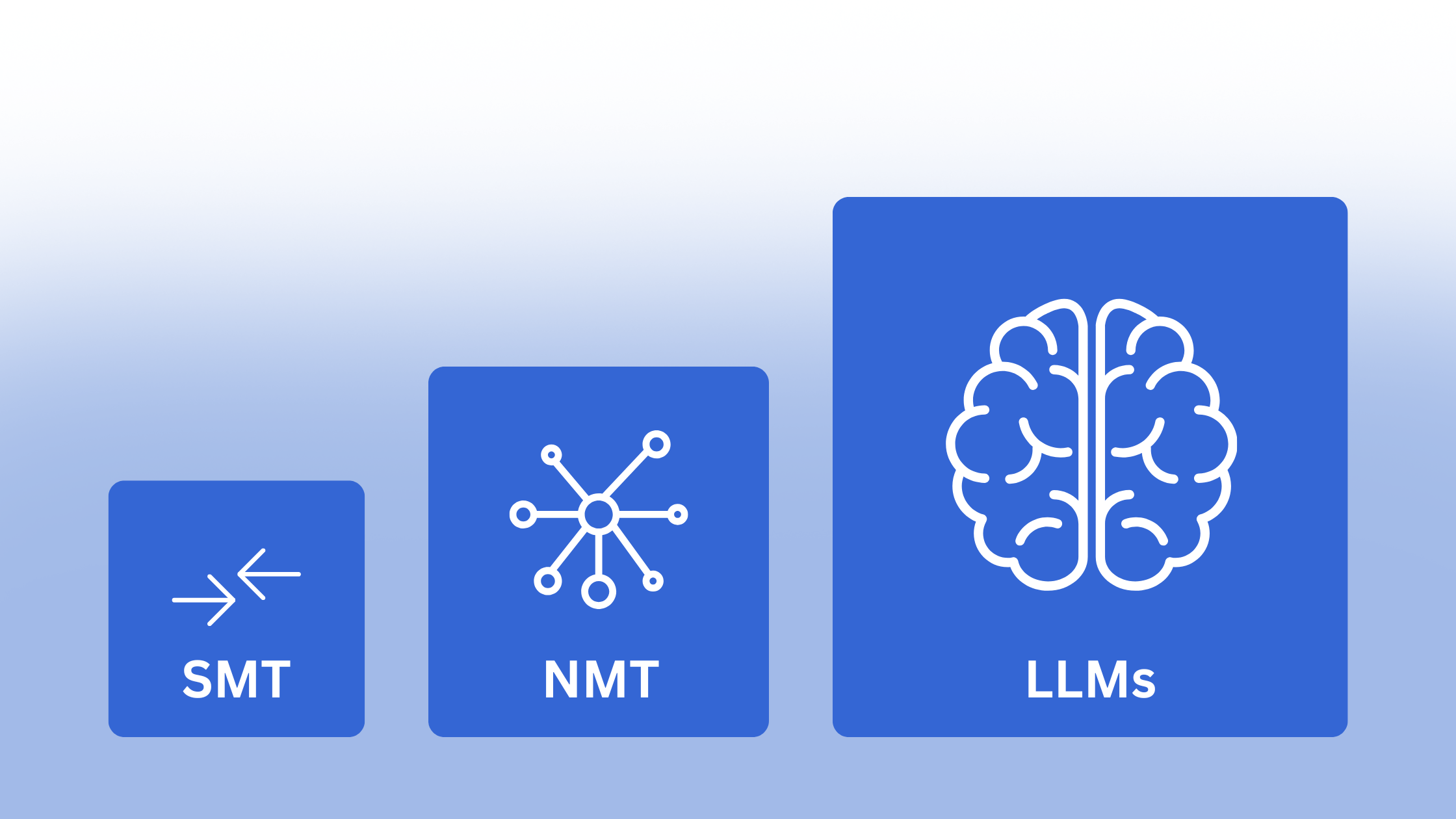
Discover how AI language translators transform global communication, remove language barriers, and support seamless cross-cultural connections in real time.
