Critical PHP security issue: What PHP2Shell teaches SaaS buyers
AI translation
Table of content

On October 21, 2026, website operators had to install emergency PHP updates or take affected services offline. The critical PHP security issue known as PHP2Shell could allow an unauthenticated attacker to run code on a vulnerable server, while attack attempts accelerated around the public disclosure. The incident shows how AI-discovered vulnerabilities can give defenders an early advantage and then create urgent work for organizations that depend on the affected software.
For software buyers, the lesson reaches beyond PHP. A provider’s security posture becomes visible when a critical flaw appears: whether it knows what software it runs, can deploy a patch quickly, preserves evidence, follows an incident plan, and can show that its controls are reviewed independently. This article explains what happened and how to assess those capabilities when choosing a SaaS provider.
PHP’s maintainers disclosed two vulnerabilities, CVE-2026-109618 and CVE-2026-109619, affecting PHP installations that serve web requests. Both could lead to unauthenticated remote code execution. Plainly speaking, an attacker might execute commands on a server without first signing in. Depending on the server’s configuration and connected systems, that access could expose data, alter a website, install malware, or provide a route into other infrastructure.
The flaws involved PHP’s handling of memory and internal state during failed or interrupted requests. One could leave request data only partly initialized after an out-of-memory condition. The other could allow internal state to survive after the memory behind it had been released. Those details matter to maintainers and system administrators, but buyers need to understand the consequence: the weakness existed below the application layer, so an otherwise well-written website could still be exposed through the software underneath it.
The PHP project released fixes in PHP 8.5.12, 8.4.27, 8.3.36, and 8.2.35. Its guidance was unusually direct: temporary mitigations could reduce exposure to particular attack paths, but updating was the only complete solution. Older unsupported PHP releases created another complication. Their operators had to find a vendor with a backported fix or move to a supported version.
Reports of scanning and attempted exploitation appeared at high volume around disclosure. Cloudflare CEO Matthew Prince reported attempts before the public announcement, followed by millions afterward. Public institutions and private operators temporarily disabled websites while they applied fixes. An attack attempt does not prove that every target was compromised, however. PHP2Shell describes a PHP security vulnerability and the attack activity around it, not a single confirmed breach of every affected service.
The discovery process is central to this incident. According to OpenAI’s account of the coordinated disclosure, Calif, a cybersecurity research firm, found a critical flaw using an AI model. Wiz, a cloud security company, independently discovered and reported both vulnerabilities. PHP maintainers led the fixes, with researchers, infrastructure providers, and government organizations coordinating protections before disclosure.
AI can examine mature code with new methods and at a scale that manual review cannot match. A model’s finding changes what defenders and attackers know about the code, turning a long-hidden defect into an immediate operational problem.
This creates a useful window for defense when researchers report findings privately. Maintainers can validate the issue, develop and test patches, alert essential infrastructure providers, and prepare detection rules before technical details become public. The PHP response shows why coordinated disclosure remains important even when AI accelerates the research itself.
Once technical details leak or are published, the speed advantage can shift toward attackers. AI tools can help them interpret a patch, develop exploit variants, and scan large numbers of systems with less manual effort. The interval between discovery, disclosure, and mass exploitation may continue to shrink, although the evidence does not show that AI independently caused the PHP2Shell activity.
Emergency patching is the visible part of incident response. The preparation behind it determines whether an organization can act in hours or spends those hours discovering which systems it operates.
A provider needs an accurate inventory of software, versions, owners, and dependencies. It needs a defined way to assess exposure, test a fix, deploy it, restart affected services, and verify that the corrected version is running. Unsupported components need an upgrade or isolation plan before a crisis occurs.
Evidence also matters. When attacks begin before or near disclosure, applying a patch answers only the current exposure question. Logs, alerts, and forensic records help determine whether someone may already have reached the system. An incident plan should name the people who make shutdown decisions, investigate suspicious activity, contact suppliers, and notify customers or authorities when required.
Regular audits test whether documented controls are operating. Independent SaaS penetration testing is also of utmost importance: it gives authorized specialists permission to look for exploitable weaknesses in a defined environment. Neither activity can prove that a product contains no vulnerabilities. Together with code review, monitoring, vulnerability management, and practiced response procedures, they provide evidence that security work is continuous rather than improvised during an emergency.
Security certifications provide useful assurance when you understand which controls and processes each one evaluates. ISO/IEC 27001 specifies requirements for an information security management system. It examines how an organization identifies risks and establishes, operates, reviews, and improves the controls used to manage them.
A SOC 2 examination evaluates a service organization’s controls against the AICPA Trust Services Criteria. A Type II report considers how the controls operated over a period, rather than describing their design at one point in time. The report’s scope, review period, exceptions, and complementary controls remain important. Buyers should request the current report and check whether the service they plan to use falls within its boundaries.
SOC 2 and ISO certification do not promise vulnerability-free software. They give procurement and security teams structured, independently assessed information about the provider’s control environment. That evidence is more useful when paired with direct answers about patching, testing, incident response, and recent findings.
The following questions connect policy claims with evidence your security or procurement team can examine.
Questions to ask | Possible evidence/metrics | Why it matters during an incident |
|---|---|---|
Which systems and subprocessors are used? | Current architecture, asset ownership, subprocessor records, and the formal scope of audit reports | The provider cannot patch or investigate components it has not identified. |
How quickly are critical vulnerabilities assessed and fixed? | Severity definitions, target remediation times, escalation paths, and recent anonymized examples | A written process helps convert an advisory into an owned action. |
How do you confirm that a patch reached production? | Deployment records, version checks, restart procedures, and post-deployment monitoring | Installing a package is insufficient if old workers or instances remain active. |
How often do independent reviews occur? | Current ISO/IEC 27001 certificate, SOC 2 Type II report, audit period, penetration-test summary, and remediation records | Dates and scope show whether the assurance still applies to the service being purchased. |
What happens if exploitation may have preceded the patch? | Retained logs, detection rules, forensic procedures, and notification criteria | The team needs to investigate earlier access instead of treating the patch as proof that no incident occurred. |
Who can take a service offline? | Incident roles, decision authority, communication templates, and exercised response plans | Clear authority reduces delay when continued availability creates greater risk. |
How are customers informed? | Security contact, status process, contractual notification terms, and customer guidance | Customers may need to rotate credentials, review integrations, or meet their own reporting duties. |
Ask for dates, scope, and remediation evidence rather than accepting a certification logo on its own. A provider may have a valid report whose review period has ended, whose scope excludes a relevant service, or whose noted exceptions deserve discussion. Procurement, security, legal, and the service owner should review the evidence together because each team sees a different part of the risk.
Localization platforms can contain unreleased product copy, terminology, documents, credentials for connected repositories, and records of who changed or approved content. A disruption can also delay releases across several markets. Those facts make enterprise SaaS security relevant to localization procurement even when the system does not process payment data.
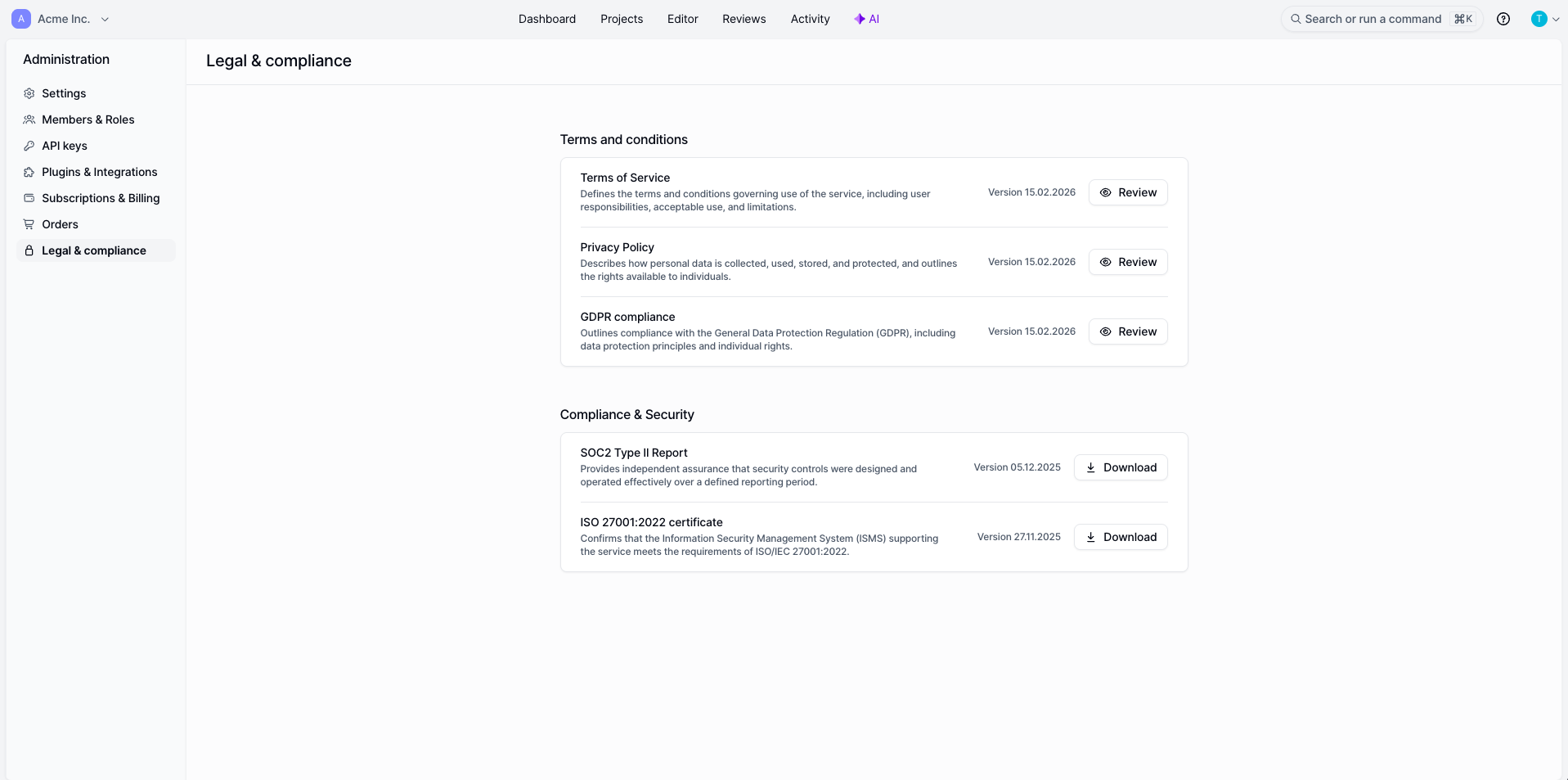
At LingoHub, our security and compliance program includes ISO 27001 certification and SOC 2 Type II attestation. We also conduct recurring audits and penetration tests and are currently completing another re-certification cycle (as of October 23, 2026). Customers can find and download our SOC 2 Type II report and ISO 27001:2022 certificate directly in the LingoHub UI under Administration > Legal & compliance. These measures do not remove every possibility of a software flaw. They provide repeatable controls, external scrutiny, and evidence that enterprise customers can include in their vendor reviews.
PHP2Shell will eventually leave the news, but the operating conditions will potentially remain. AI-assisted research can expose weaknesses in mature software faster, and attackers can automate their response. Buyers therefore need providers that can identify affected systems, patch them, investigate possible access, communicate clearly, and show current evidence for those capabilities.
Ready to explore a translation management system backed by ISO 27001 certification, SOC 2 Type II attestation, and GDPR-aligned data handling?
AI orchestration in localization: A 2026 overview
Learn how AI orchestration in localization helps enterprises scale translation workflows with AI agents, governance, terminology control, and human review.
AI judgment in localization: deciding where humans belong
Learn how AI judgment in localization helps teams decide what to automate, what context AI needs, and when human review protects quality.
AI localization: Supercharge your translation workflow
AI localization uses artificial intelligence to streamline translation workflows, improve quality, and scale global content faster. Learn more in our blog.
AI localization insights from the Nimdzi 100 2026 report
Explore the key findings from the 2026 Nimdzi 100 report, including AI localization, automation, human review, and the future of enterprise localization.
