Brand tone of voice: How to define it with examples
Product localization
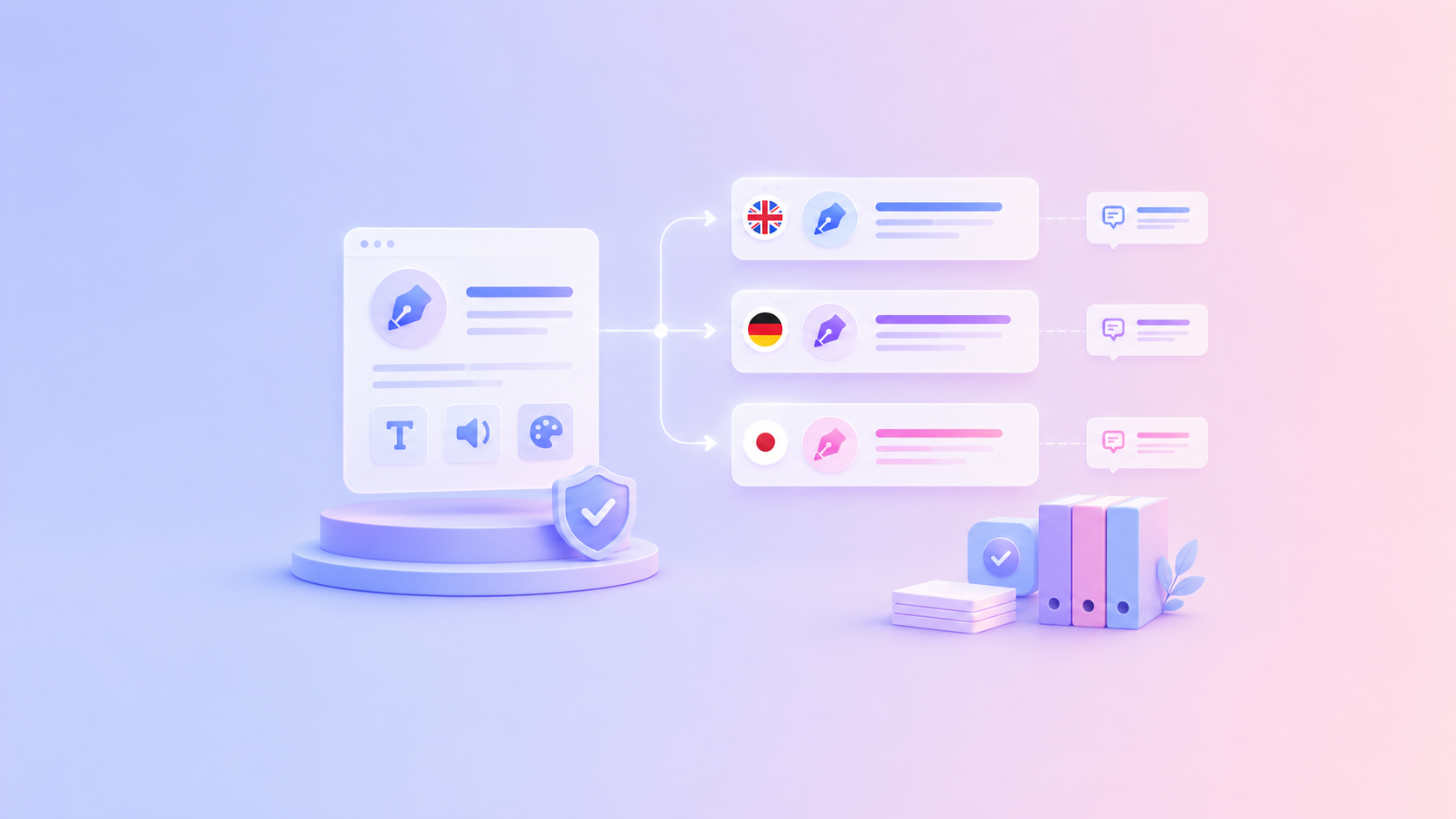
Table of content

A strong tone of voice helps every message sound like it comes from the same company, whether it appears on a website, in a product email, on LinkedIn, or in a localized campaign. A brand voice is the recognizable personality behind your communication, while tone adapts that personality to the situation.
For international organizations, consistency alone is not enough. Your brand needs to sound familiar across every market, while still feeling natural in each language. A sentence can be accurate, on-brand, and still feel slightly translated. The goal is to sound like yourself and like a native in each and every market.
Brand tone of voice is the way your brand personality comes through in words. It shapes how formal, warm, direct, playful, technical, emotional, or concise your communication feels.
A tone of voice should guide real writing decisions: which words to use, how long sentences should be, how much humor is appropriate, how directly you address the reader, and how your brand responds in sensitive moments. For example, a cybersecurity company may define its voice as clear, calm, and expert. In a product update, that voice can sound precise and confident. In an incident communication, the tone should become more careful, transparent, and reassuring.
Brand voice and tone are closely related, but they are not identical. Brand voice is the stable personality. Tone is how that personality sounds and how it adapts to the context.
Concept | What it means | Example |
|---|---|---|
Brand voice | The consistent personality of your brand | Helpful, confident, precise |
Tone of voice | The expression of that personality in a specific situation | Warm in onboarding, calm in support, concise in product UI |
Style | The writing rules that make the voice usable | Sentence length, capitalization, vocabulary, formatting |
Think of a person you know well. They do not speak the same way in a meeting, at dinner, and while giving difficult feedback. Still, they sound like themselves. That is the relationship between brand voice and tone.
Use this rule: your brand voice should stay recognizable. Your tone should adjust to the reader’s situation.
Brand tone of voice matters because text carries trust, intent, and identity. It is the voice through which your organization communicates who it is.
In international companies, that voice travels through many hands: (global) marketing, regional teams, translators, agencies, product managers, support teams, and AI tools. Without clear guardrails, every handoff can slightly change the message.
This is especially visible in localization. A campaign may be translated correctly, but still feel too stiff, too informal, too literal, or too far from the brand’s usual style. For global teams, the challenge is to keep the key message intact while giving each market enough room to sound natural.
For a broader view on adapting content across markets, read our guide on content localization strategy in the era of AI.
Example: a brand with a warm, plainspoken voice should not become overly corporate in German, overly casual in Dutch, and overly literal in French. The local version should feel native, but still carry the same confidence, personality, and intent.
Even organizations with strong English copy often lose consistency during localization. The challenge is rarely translation quality alone. Brand voice can be inconsistent when different translators, agencies, AI tools, or regional teams interpret the same message differently.
Common causes include:
inconsistent terminology
missing style guidance
translating idioms literally
different levels of formality
AI tools without brand context
no review process across markets
An authentic brand voice therefore requires a repeatable localization workflow.
To find your brand voice, start with evidence rather than preference. Listen to audience feedback, positioning, product experience, and best-performing content.
Review existing materials such as website pages, sales decks, product emails, support replies, social posts, customer stories, product UI copy, and high-performing campaigns. Look for patterns: which pieces sound most like the company? Which ones sound generic? Which words appear often? Which expressions feel outdated or off-brand?
Then turn those observations into three to five voice principles. More than that becomes hard to apply.
Principle | Meaning | Implication for the writing process |
|---|---|---|
Clear | We make complex topics easier to understand | Use concrete language and short explanations |
Helpful | We guide rather than lecture | Give useful next steps |
Confident | We know our field | Avoid hedging and vague claims |
Human | We sound like people, not a policy document | Use natural phrasing and avoid unnecessary jargon |
Pro tip: Gather feedback within your company. Ask five people from marketing, sales, product, and customer success to highlight one piece of copy that “sounds most like us.” This exercise often reveals your real brand voice.
To define a brand voice, translate brand strategy into guidelines for writing. Values such as “innovative,” “trusted,” or “customer-centric” are too broad on their own. Writers need rules they can apply sentence by sentence.
A useful brand voice definition should include voice principles, tone spectrum, vocabulary preferences, words to avoid, examples by channel, localization notes, and rules for AI-generated text.
Avoid defining your brand voice only as adjectives. “Friendly, bold, and expert” can mean ten different things to ten different writers. Add before-and-after examples that show the difference.
Instead of | Write |
|---|---|
revolutionize | simplify |
cutting-edge | practical |
leverage | use |
unlock value | help teams |
world-class | proven |
To create a brand voice guide, make it useful enough for daily work. A polished PDF that no one opens will not change how teams write.
Your guide should help people make fast writing decisions. It should answer: How do we sound? What do we avoid? How do we write across channels? How do we adapt tone for sensitive topics? How do we keep the voice consistent in translation?
Section | What’s included? |
|---|---|
Voice principles | 3-5 core traits of your brand with explanations |
Tone spectrum | How the tone changes by situation |
Vocabulary | Preferred terms, banned words, product names |
Channel examples | Website, email, social, product UI, support |
Localization notes | Formality, idioms, cultural references, do-not-translate terms |
AI guidance | Prompting rules, review steps, approved examples |
For localization, your brand voice guide should also be available inside your translation management system or CAT tool, so translators and reviewers can access it without switching between documents. This helps translators, reviewers, and AI tools apply the same rules while they work, rather than checking a separate document after the translation is already done.
LingoHub helps teams manage brand voice across languages by combining glossaries, style guides, translation memory, review steps, and QA checks in one workflow. Its style guide feature lets teams define rules for audience, formality, voice, vocabulary, language complexity, and AI context, so translations stay aligned with the intended brand tone across markets.
Brand voice examples make guidelines easier to apply because they show how the same personality changes across formats.
A website headline can be more polished. A product tooltip needs to be concise. A support reply should be calm and useful. A social post can carry more warmth or immediacy.
Example: same voice, different channels
Website: “Manage multilingual content with clarity and control.”
Product UI: “Upload your translation file.”
Support: “I checked the file and found the issue. The placeholder is missing in the German version.”
Social: “Launching in new markets? Your content should sound local, not just translated.”
Email: “Here is a quick overview of the translation updates ready for review.
”
See? The voice stays consistent: clear, useful, and composed. The tone changes based on the channel and the reader’s context.
Example: Imagine your team launches a new feature called “Review workflows”. The English campaign describes it as “simple and collaborative.” During localization:
German copy becomes more formal while keeping the same confident tone.
French marketing adapts the CTA to sound less direct.
Japanese avoids overly promotional wording.
Spanish keeps the brand’s conversational style without translating English idioms literally.
Although the wording changes, customers in every locale and market should still recognize the same brand personality. This is why brand voice guidelines should define intent and tone rather than prescribe exact wording. For additional information read our guide on how to scale international campaigns with marketing translation.
Social media guidelines should define how formal posts should be, whether emojis are allowed, how to write hooks, how to respond to comments, which claims need approval, and which topics require extra care. A useful social rule might be: “Write like a knowledgeable colleague, not a motivational poster.” That allows warmth without pushing the brand into empty enthusiasm.
Too generic:
“Ready to revolutionize your global content strategy?”
More specific:
“Expanding into new markets is easier when your product copy, website content, and translation reviews stay connected.”
The second version says more, sounds more credible, and gives the reader a concrete reason to care.
To adapt AI-written text to your brand voice, give the AI the same context you would give a human writer. A generic prompt usually produces generic copy.
Example prompt:
"Rewrite this paragraph in our brand voice.
Audience: B2B SaaS marketing managers
Channel: website
Voice: clear, helpful, confident, human
Avoid: hype, vague claims, overly casual phrasing
Use: “translation management”, “review workflow”, “quality checks”
Goal: explain how teams keep multilingual content consistent"
Keep in mind, though, AI cannot infer your brand voice from a single prompt. Useful context includes target audience, channel, message goal, brand voice principles, terms to use, terms to avoid, formality level, approved examples, market, and legal or product constraints. That’s why enterprise teams provide structured guidance rather than relying on prompting alone.
For AI-assisted localization, context is what turns a generic draft into useful brand communication. Learn more about context management in AI agents for localization.
With LingoHub and LINA, teams can use AI within the localization workflow, supported by glossary, style guide, translation memory, and project context. LINA can help translate, rephrase, shorten, suggest variants, review, and check quality while teams decide how much autonomy is appropriate.
Brand voice often weakens across markets through small inconsistencies, not one bad translation.
Slogans and campaign messages should not always be translated literally. When emotion, humor, or cultural meaning matters, transcreation is often better than direct translation.
Terminology also needs control. Product names, feature labels, and key concepts should follow an approved glossary so translators, reviewers, and AI tools make consistent choices.
Formality can change by locale, but the brand personality should stay recognizable.
AI-generated content also needs context. Without style guides, approved terminology, and previous translations, it often sounds generic.
Finally, brand voice guides should live inside the localization workflow, TMS, or CAT tool so teams can apply them while they work.
A strong brand tone of voice helps customers recognize your company wherever they meet it.
Local teams in international organizations need room to write naturally for their markets. The key is to protect the brand’s intent, terminology, and personality while allowing tone to adapt to language, channel, and context.
LingoHub helps global teams manage that balance across languages. The goal is to make every customer feel they’re interacting with the same company, whether they’re reading your website in English, German, Japanese, or Spanish.
Build localization processes that keep multilingual content accurate, consistent, and ready for every market. Start your free trial now or book a demo.
Does the copy sound like the same company across channels?
Is the message clear within the first few seconds?
Are the most important terms consistent?
Does the tone fit the situation?
Is the level of formality right for the audience and market?
Are vague claims made more specific?
Are idioms, humor, or cultural references safe for localization?
Are product names and feature names written correctly?
Has AI-generated text been reviewed against the brand voice guide?

How to scale international campaigns with marketing translation
Marketing translation helps teams scale 2026 campaigns with AI and human nuance. Learn to choose services and use LingoHub to streamline your workflow.

Marketing localization: Adapt content for global markets
Marketing localization is an essential part of going global. Read our article for more information about adapting marketing content for worldwide success.
