Best LLM for translation: a comparison of leading models
AI translation
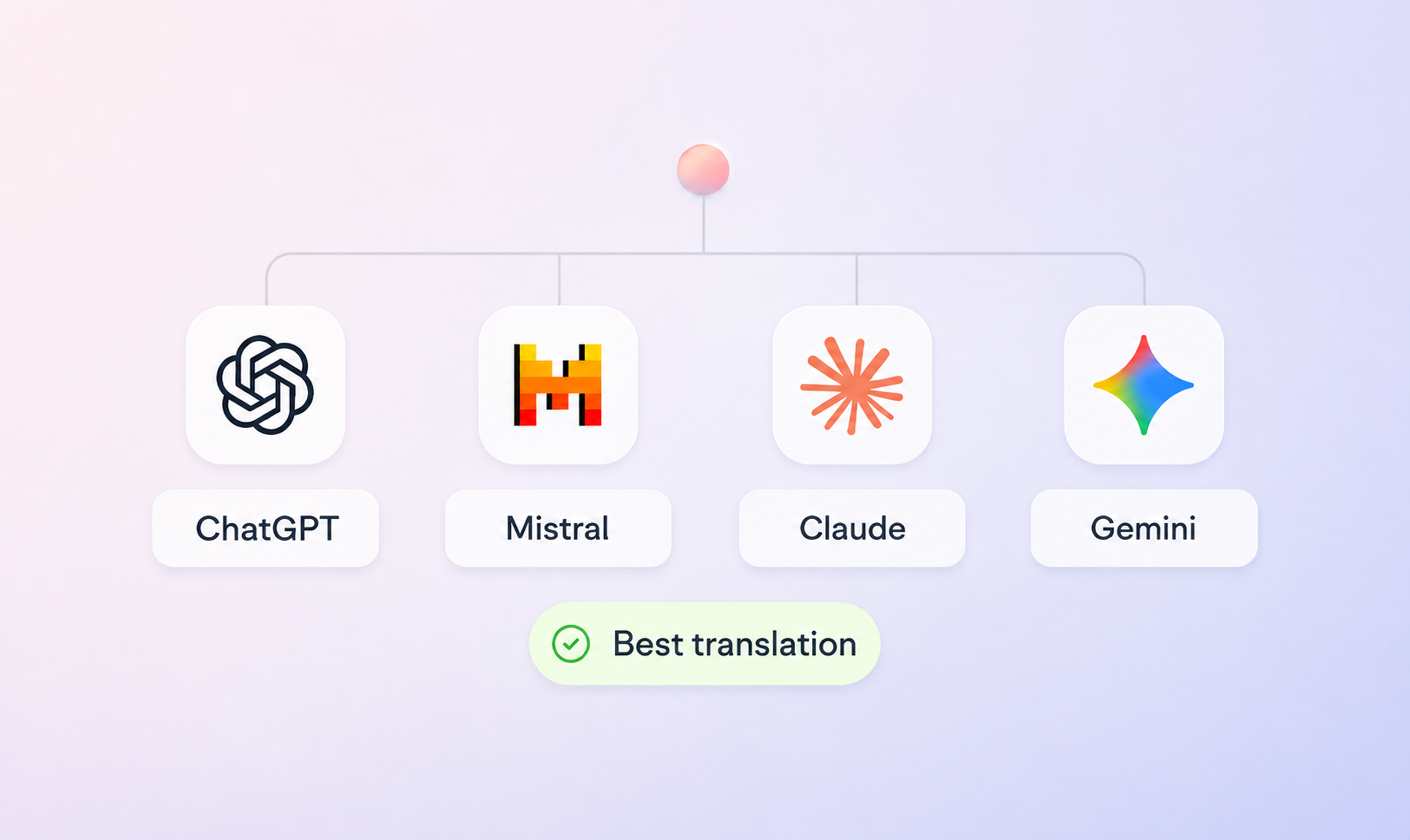
Table of content

Choosing the best LLM for translation depends heavily on what you need to translate. A model that performs well for marketing copy may not be the best choice for technical documentation, while language pairs, terminology, security requirements, and cost can further influence the decision.
This guide compares Claude, Google Gemini, Mistral, and OpenAI GPT to help you understand their strengths and choose the right model for your content and workflow.
The same model can produce very different results depending on the content and language pair. It may preserve the tone of a campaign while changing a required product term, or translate a help article well while leaving an important condition out of a short interface string. Model updates can alter the result again.
Independent research illustrates why rankings need careful interpretation. A WMT 2024 translation study found that LLMs trailed neural machine translation, technology built specifically for translation, in the English-to-German test. The LLMs were competitive for English-to-Russian. The study also identified errors involving names of people, organizations, and places; specialized terms; who did what to whom in a sentence; unnecessarily long responses; and responses with no translation. The results do not establish a definitive ranking of the models.
The WMT 2025 general translation task used 30 language pairs, texts from several subject areas, source texts with more complex language and structure, complete documents instead of isolated sentences, and professional human reviewers.
The following table turns broad claims about an AI translation model into evidence you can collect.
Criterion | Question to test | Evidence to record |
|---|---|---|
Meaning preservation | Does the output retain facts, negation, requirements, numbers, and intent? | Errors grouped by how much they change the message |
Language-pair performance | Does quality remain acceptable in each direction, such as English to German and German to English? | Separate scores for every language direction and target market, including lower-volume languages |
Terminology | Does the model use approved terms and preserve protected names? | Percentage of approved terms used correctly, reviewer corrections, and consistency |
Context | Does surrounding text resolve pronouns, ambiguous labels, and references? | A comparison of output with and without surrounding text |
Tone and brand voice | Does the output follow the style guide without changing meaning? | Ratings from your reviewers in each target market against agreed tone and style rules |
Consistency in longer content | Do terms, names, and voice remain stable across sections? | Checks of repeated terms and names across the complete document |
Following instructions | Does the model follow do-not-translate rules, formatting, and output requirements? | Added commentary, missing content, and formatting changes |
Speed, scale, and cost | Can the service process the required amount of content quickly enough and stay within budget? | Processing time, failed requests, usage cost, and reviewer time |
Security and privacy | Does the exact service and plan meet data-handling requirements? | Contract terms, where data is stored and processed, how long data is kept, other providers that process the data, access controls, and security reports |
Quality deserves more than one score. A fluent sentence can contain the wrong date, reverse a condition, or replace an approved legal term. ISO 5060:2024 describes a method your reviewers can use to classify errors and give more weight to mistakes with greater consequences.
Define acceptable error limits before your reviewers see model names. Hiding the model names reduces brand preference. Give more weight to errors that change a legal obligation, safety instruction, or product claim than to wording preferences. This prevents many polished sentences from masking one consequential mistake.
Single-version rankings age quickly. The table below highlights the types of content each model may handle well and gives a concrete example to include in your comparison. These are starting points, not fixed conclusions.
Model | Use case | Example content to test | What to confirm |
|---|---|---|---|
Claude | Tone, creativity, and brand voice | A marketing campaign, social media post, or product page that needs to retain the brand’s personality | Accurate meaning with fewer tone and style corrections than the other models |
Google Gemini | Consistency across large amounts of connected content | An entire help center or software documentation set where terminology and wording must remain consistent across hundreds of pages or files | Stable terminology, names, and references across the complete content set |
Mistral | Multilingual content, including the European languages listed in Mistral’s documentation, together with hosting and cost requirements | A product catalog, support center, or software documentation translated for several European markets within your approved hosting setup | Required quality for every language pair within your organization’s hosting, speed, volume, and cost limits |
OpenAI GPT | Technical and structured content with detailed formatting instructions | An app interface containing placeholders such as | Accurate meaning with no missing or changed placeholders, variables, tags, or formatting |
Give each model the same source, surrounding text, glossary, previous translations, style guide, and output rules. Record the exact model, settings, and test date.
Report results by language pair, content type, error type, and how seriously each error affects your readers. A strong average for support content cannot offset a critical error in a contract.
The model choice becomes clearer when content is grouped by what it needs to do and what could happen if the translation is wrong. This table shows what to check and who should review each common content type.
Content type | What to check | Errors that need the most attention | Review approach |
|---|---|---|---|
Product interface | Context, terminology, placeholders, length, and consistency | Wrong action, altered variable, ambiguous label | Linguistic review plus in-product checks |
Marketing and communications | Meaning, tone, claims, formality, locale fit, and brand voice | Changed claim, unsuitable tone, invented detail, prohibited phrase | In-market brand review before publication |
Help and support content | Accuracy of instructions, product terms, and consistency after updates | Missing condition, wrong sequence, changed warning | Review instructions where an error could cause harm or confusion; check a sample of updates where errors have limited consequences |
Legal, medical, or financial content | Exact meaning, defined terms, numbers, obligations, and the ability to track changes and approvals | Any change that affects rights, safety, diagnosis, treatment, or financial decisions | Approval from a qualified linguist and a legal, medical, or financial expert |
Internal communication | Comprehension, confidentiality, names, dates, and tone | Exposure of sensitive data, wrong deadline, incorrect responsibility | Use an approved service and require closer review when a mistake could affect people or decisions |
Short content is not automatically easy. The label “Save” may be a command, a state, or a financial benefit. Provide the screen, audience, character limit, and neighboring text. For long content, check that wording remains consistent and no text is missing.
A fair comparison gives every model the same inputs. A single sentence or interface string rarely contains all the information a translator uses.
Context: Supply the content type, audience, target country or language variety, surrounding text, and placement.
Glossary: Use a shared glossary to define approved translations, protected names, forbidden alternatives, and ambiguous terms. Assign an owner for each market.
Translation memory: Reuse approved sentence-level translations to reduce unnecessary variation.
Style guide: State formality, address, capitalization, units, and brand preferences. Add a few approved examples.
Output rules: Protect placeholders, markup, product names, numbers, and file structure.
You can configure different AI engines for LINA and run the same sample of your actual content through each one. LINA applies your project’s glossary, translation memory, surrounding text, and style guide. You can then review and compare the outputs, record the corrections each one needs, and choose the engine that works best for each language pair and content type.
A study of specialist knowledge for LLM translation found that relevant example translations worked better than a list of terms alone. A WMT 2025 medical translation study found the largest gains with one to three examples from the same subject area and writing style.
Glossaries and examples still need checking. A term may need to change form to match the grammar of a sentence, while a reused translation may carry the wrong meaning in a new context. Your reviewers need the source, surrounding text, glossary, and style guide beside the output.
LLM translations can read smoothly while containing errors that are difficult to notice at a glance. A sentence may sound natural in the target language even after the model has left out an important condition, changed who performs an action, or replaced an approved product term. Your reviewers need a shared list of error types to assess each model in the same way and identify which checks can stop the same issue from reaching publication.
Missing content: An important condition, sentence, or warning disappears. Compare the source and translation to find missing text, then send the affected content to a reviewer.
Addition or hallucination: The output introduces unsupported information. Restrict the task to supplied content and check names, claims, dates, and numbers.
Changed meaning: The model changes whether something is required, optional, or prohibited; who performs an action; when it happens; or how two points relate. Use bilingual review and distinguish wording preferences from errors that change the message.
Terminology error: An approved term is replaced, mistranslated, or used inconsistently. Apply a maintained glossary and run terminology checks after generation.
Style drift: Voice or formality changes within a document. Provide locale-specific rules and compare repeated passages.
Format damage: A placeholder, tag, link, or other element that must remain unchanged is altered. Lock this content and check it before approval.
Instruction failure: The model adds notes, alternatives, or source text. Give it exact instructions and reject responses that ignore them.
Automated quality checks can verify missing text, changed placeholders, terminology, and formatting. They cannot determine whether a sentence preserves a legal obligation or fits a market. Our article on combining AI and human translation explains which tasks automated checks can cover and which still need a person. Content needs closer human review when a mistake could cause more harm or confusion.
Build a test set from published content. Include routine material and difficult cases involving unclear terms, approved terminology, references to earlier sections, tone for a specific market, numbers, placeholders, and specialist knowledge.
Define the decision: Name the language pairs, content types, amount of content, acceptable processing time, security requirements, and budget covered by the comparison.
Create a sample that reflects the actual work: Include routine and difficult content. Keep a separate set of examples that may produce rare errors with serious consequences.
Use the same inputs: Give every model the same source, surrounding text, glossary, examples, style rules, and output requirements.
Establish the review method: Use qualified bilingual reviewers and a shared list of error types. Hide model names from reviewers and define how they should distinguish wording preferences from changes in meaning.
Calculate the full cost: Record model usage, processing time, failures, reviewer minutes, and corrections.
Test repeated content and updates: Check whether the model preserves approved choices and handles a source change without carrying over outdated wording.
Set publishing rules: Define which content may be published after automated checks, which requires review of a sample, and which always needs approval from a named person.
Our overview of selecting models, running checks, and assigning reviewers with AI explains how these steps can be coordinated within one process.
Alongside the four LLMs, test a machine translation tool designed specifically for translation when it supports your required languages and amount of content. Its results give you a useful point of comparison for quality, speed, and cost. WMT findings show that a general-purpose LLM does not automatically outperform a translation-specific system for every language pair.
Translation requests can contain unreleased product information, personal data, contracts, or regulated material. Assess the exact service, region, settings, and contract. Consumer and enterprise products from one provider may follow different terms.
Official documentation shows why you need to check the exact product and plan. Anthropic states that commercial Claude inputs and outputs are not used for training by default, except when customers choose to share data or submit feedback as described on the page. OpenAI’s API data controls explain how training use, storage time, and saved data differ between API features. Google documents which settings prevent submitted content from being stored. Mistral provides separate terms for commercial services, partner-hosted services, and models hosted on customer infrastructure.
Check whether the provider uses submitted text for training, where it stores and processes the text, how long it keeps the data, which other service providers can process it, who can access it, and how it is deleted. Ask for security reports or certifications, and repeat the review when the provider, plan, or hosting setup changes.
Calculate the cost of model requests, failed requests, connections between systems, translation checks, reviewer time, and corrections. Measure how long files matching your actual sizes and formats take and how much content the service can process during busy periods. Record the date and assumptions behind every estimate.
An LLM’s first translation is a draft that still needs to pass your internal checks and approval rules. Before publication, your localization workflow supplies surrounding text, the glossary, translation memory, and style guide. It also protects placeholders and formatting, flags errors, sends the text to the right reviewer, and returns the approved translation to your publishing system.
Our AI translation workflow supports multiple AI engines, including Claude, Google Gemini, Mistral, and OpenAI GPT. You can select an engine according to your content, language pair, and quality requirements instead of committing every project to one model provider.
The selected engine remains connected to your terminology, translation memory, quality checks, and reviewer roles. You can change or compare models without rebuilding these controls for every project.
There is no universal winner across every language pair, subject area, and content type. Test Claude, Google Gemini, Mistral, and OpenAI GPT on a sample of your actual content with the same surrounding text, glossary, translation memory, and style guide. Select the model that meets the required quality, security, processing time, and total cost.
The answer may differ within your organization. Marketing copy emphasizes tone and brand voice. Product interfaces require context, terminology, placeholders, and checks inside the product. Legal, medical, and financial content requires exact meaning and qualified approval. Set separate requirements for each content type.
No. Model size and release date do not establish performance for a particular language pair, terminology set, or instruction pattern. Compare the exact models available in the production setup and include review effort, processing time, price, and security in the decision.
Require qualified review when an error could affect rights, safety, health, financial decisions, contractual meaning, or public claims. Content where errors have limited consequences may qualify for automated checks or review of a sample after testing shows consistent results. Record who reviews the content and who handles problems.
Both affect the outcome. The model influences the first translation. The workflow supplies surrounding text, terminology, previous translations, checks, reviewer approval, and the path to publication. Replacing a model cannot correct unclear source content, a missing glossary, weak tests, or unclear review rules.

How to choose a translation management system: A buyer’s checklist
Use this practical checklist to evaluate translation management systems by integrations, AI, security, workflows, pricing, support, and scalability.
From SMT to LLMs: How AI language translators have evolved
Discover how AI language translators transform global communication, remove language barriers, and support seamless cross-cultural connections in real time.

AI localization: Supercharge your translation workflow
AI localization uses artificial intelligence to streamline translation workflows, improve quality, and scale global content faster. Learn more in our blog.
