Right-to-left languages: list by script, with language codes
Product localization
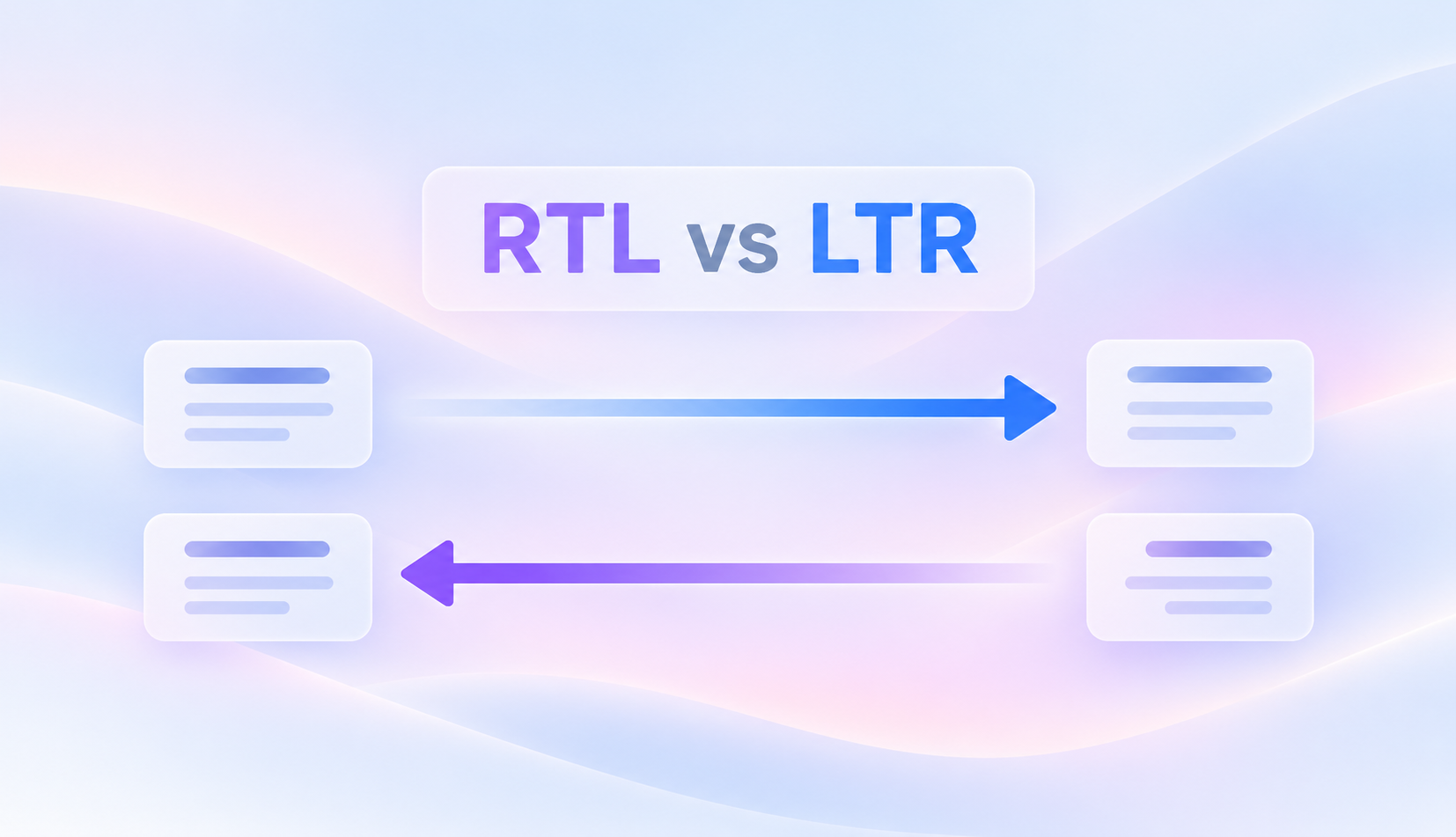
Table of content

Arabic, Hebrew, Persian (Farsi), Urdu, Pashto, Sindhi, Uyghur, Central Kurdish (Sorani), Yiddish and Dhivehi are the main languages written right to left. The W3C counts 13 right-to-left scripts in modern use and 216 languages written in them, 189 of those in the Arabic script.
A language takes the direction of the script it’s written in. Azerbaijani shows why that matters: in Iran it’s written in the Arabic script, right to left, and in Azerbaijan in the Latin script, left to right. So when you plan an RTL locale, start with the script your readers use.
Script | Main languages | Language codes |
|---|---|---|
Arabic | Arabic, Persian (Farsi), Dari, Urdu, Pashto, Sindhi, Uyghur, Central Kurdish (Sorani), Punjabi in Pakistan, Kashmiri | ar, fa, prs, ur, ps, sd, ug, ckb, pa-Arab, ks |
Hebrew | Hebrew, Yiddish | he, yi |
Thaana | Dhivehi (Maldives) | dv |
Syriac | Assyrian and Chaldean Neo-Aramaic, Classical Syriac in church use | aii, cld, syc |
N’Ko | Bambara and Dyula, which are also written in Latin | bm, dyu |
Adlam | Fulah (Pular), more often written in Latin | ff |
Hanifi Rohingya | Rohingya | rhg |
Garay, Mandaic, Mende Kikakui, Old Hungarian, Samaritan, Yezidi | Small communities, minor or religious use |
Languages written in more than one script
Their direction depends on the script you localize into:
Punjabi is written in Gurmukhi (left to right) in India and in the Arabic script, called Shahmukhi (right to left), in Pakistan.
Kurdish depends on the variety. Central Kurdish (Sorani) is written in the Arabic script. Northern Kurdish (Kurmanji) is written in Latin, mostly in Turkey and Syria, and in the Arabic script, mostly in Iraq and Iran.
Hausa is written mostly in the Latin script today, with the Arabic script as a second option.
For these languages, add a script subtag to the language code so your files and your translators know which version they’re working on: pa-Arab for Punjabi in the Arabic script, ku-Latn for Northern Kurdish in Latin. A script subtag is four letters and comes right after the language code. Our guide to ISO 639 language codes explains the rest of a language tag.
As the name implies, RTL is a group of scripts written from right to left. Right-to-left (RTL) or bidirectional languages are uncommon in most Western countries, especially when overviewing the web environment. Based on the Statista research in 2023, the top 5 most popular languages for web content are left-to-right (LTR), with a total market share of around 75%.
It could seem that localization to RTL languages wouldn’t be profitable enough in the context of the statistic above. But let us destroy this delusion with precise figures.
First of all let’s define the most widespread RTL languages:
Language | Number of speakers | Countries |
|---|---|---|
Arabic | ~ 370 million | Bahrain, Egypt, Jordan, Kuwait, |
Hebrew | ~ 8 million | Israel |
Persian (Farsi) | ~ 81 million | Iran, Afghanistan, Tajikistan, Dagestan(Russia) |
Urdu | ~ 70 million | Pakistan, India |
Kashmiri | ~ 7 million | India (Jammu and Kashmir regions) |
Pashto | ~ 51 million | Afghanistan |
Uyghur | ~ 11 million | China (Xinjiang) |
Sorani Kurdish | ~ 7 million | Iraq |
Punjabi | ~ 156 million | Pakistan and India (Punjab region) |
Sindhi | ~ 30 million | Pakistani (province of Sindhi) |
Arabic is the fifth most spoken language in the world, with more than 370 million speakers, and is one of the six official languages of the United Nations.
Around 6 million people speak Hebrew as a native language, and above 2 million as a second.
Persian or Farsi has approximately 110 million speakers in the world.
By counting only these three RTL language data, we can see that almost 500 million people can be your business customers with the right localization strategy.
Arabic is the official language in 16 countries and co-official in 7 countries of Asia and Africa (Egypt, Kuwait, Lebanon, Qatar, Saudi Arabia, UAE, etc.)
Around 65% of Israel speaks Hebrew.
Persian, (which uses the Arabic alphabet) is spoken in around 26 regions.
When you go to the new market, you will do detailed research on the region. Just consider the countries like Kuwait (which has 9% of world oil reserves) or Saudi Arabia, which shows a constant economic rise.
So “to be or not to be” isn’t a question - the West/Middle Asian and South African markets could be an outstanding direction for your business, and localization to these regions will bring you a profit.
Regarding content localization for RTL-oriented languages, there are multiple challenges to consider. Not only is language translation a priority, but it is also essential to ensure that the content appears visually appealing. Let’s overview the principal troubles you can face during RTL language localization. We divided them into three main groups - design, development, and translation.
Text direction
One of the crucial challenges for RTL language localization is text direction and, as a result, the elements’ location. Remember that while the text is written and reading RTL, the numbers have the opposite direction - LTR. For example:
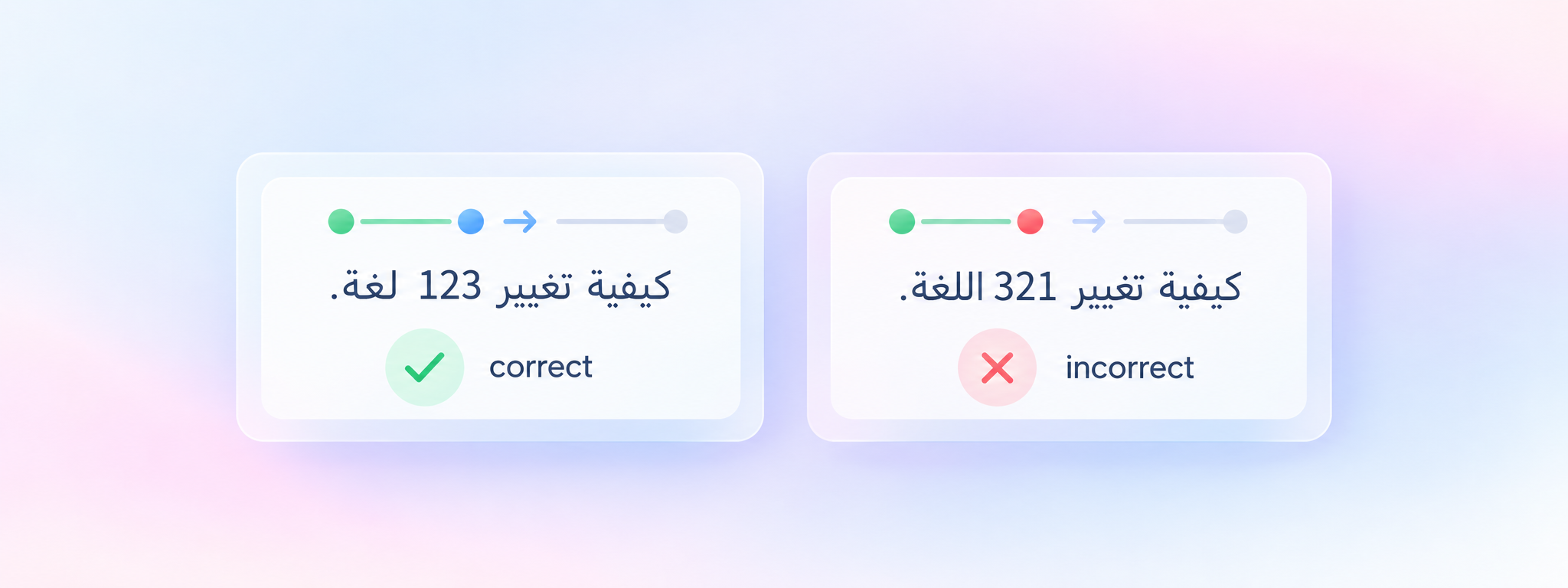
The RTL language peculiarity will require a design mirroring from the menu to the full navigation, buttons, etc. Recheck all the nuances twice. In the process of UI mirroring, do not forget that not all elements require such action. For example, the playback buttons, progress bars, etc., should be kept as are.
Fonts
You should find from the start the font, which will be readable with the appropriate size for native speakers. Also, remember that RTL scripts can be different in the context of the height of symbols, so your team should take care of the margins.
Cultural fitting of visual elements
Besides technical questions about the design, you must take care of the national and cultural peculiarities of the region. Many countries from the RTL language group are Muslim and have the opposite view of everyday European things (some gestures can be offensive in the region, etc.) So all your images, icons, logos, etc., must be tested and approved by the local expert or the testing group.
One of the exciting examples of RTL language localization is Netflix. With the pseudo localization technique, they are providing service for more than 150 countries.

Read more about Netflix localization
—> Famous product localization overview
Implementation of RTL support in some components
For the RTL version, everything must be turned (positioning, margin/padding, text alignment) the other way. The development team works with a separate style file or expands the existing CSS file. At first glance, it may seem straightforward. However, take, for instance, the slider, which only supports positive values in order. You can’t just turn it. You’ll need to flip the axis and alter the values accordingly.
Unsupported RTL features
Not all things could be just mirrored. Many countries that use RTL languages have unique rules for habitual things. One such difference is a calendar system. For instance, Saudi Arabia and other Gulf countries use the Hijri calendar, which is based on lunar observations and cannot be calculated like the Gregorian calendar. In such cases, the development team needs to come up with a new solution for displaying the calendar.
Lack of the cultural understanding Without living in the country or region, you will never understand the local population, their habits, and cultural norms at the right level for qualified localization. Especially when we are talking about East culture - "The East is a Delicate Matter." That's why one of the first steps for effective localization is hiring native linguists or experts who can:
support your business by building the strategy inside the region,
provide the information for the style guide,
proofread translations and build a correct term base.
For instance, some names like “Twitter” are used in the Western world without any alterations. This rule applies to countries with Romano-Germanic, Slavic languages, etc. However, in Arabic, there is a suitable word that translates to Twitter. If you use the word “Twitter,” Arabic-speaking users can misunderstand you. Take a look at the example for two versions.

LingoHub supports over 100 languages and dialects, including right-to-left (RTL) languages such as Arabic and Hebrew. Whether you’re localizing your product for Arabic (Algeria) – ar-DZ, Arabic (Bahrain) – ar-BH, or Arabic (Egypt) – ar-EG, LingoHub helps you manage translations, maintain consistency, and integrate localization into your existing workflows.
Translate and review content with LINA
LINA, the AI inside LingoHub, helps you translate, review, and approve multilingual content. She uses your company’s glossary, translation memory, and style guides to produce translations that reflect your terminology and brand voice. You can choose how much of the process LINA handles, from assisting human translators to autonomously managing translations and reviews.
Maintain a consistent brand voice with style guides
Different markets may require different tones, expressions, and cultural considerations. With LingoHub’s style guides, you can define language-specific writing rules, tone of voice, and audience preferences. This helps ensure your product communicates consistently while adapting to local expectations.
Use the right terminology with glossaries and translation memory
Terminology can vary significantly between languages and regions. LingoHub’s glossary helps maintain consistent translations of product names, technical terms, and industry-specific expressions. Translation memory reuses previously approved translations, reducing repetitive work and keeping your messaging consistent across projects.
Test RTL layouts early with the Figma integration
RTL localization affects more than text. Layout direction, navigation, alignment, and interface elements may need adjustments. With LingoHub’s Figma integration, you can exchange content between your designs and translation projects, helping your team identify potential layout issues earlier. Learn more about the benefits of a localization-first approach to UX design.
Work with professional translators when needed
For content that requires additional linguistic or cultural expertise, you can order professional translations directly through LingoHub. Native-speaking linguists can access your project’s terminology, style guides, and relevant context to help ensure translations meet your quality expectations.
Read more:
—> Localization of Figma design
The W3C lists 216 modern languages written in 13 right-to-left scripts.
No. Hebrew, Persian, Urdu and many other languages are also written right to left, most of them in the Arabic script. The table above groups them by script.
Not in horizontal text, which runs left to right. In traditional vertical layout, characters run top to bottom and the columns move from right to left, so a vertical page starts at its right edge. Our guide to languages with vertical scripts covers how to localize them.
Add dir="rtl" to the html tag, next to the lang attribute, for example <html dir="rtl" lang="ar">. The language tag doesn’t set direction on its own, even with a script subtag. In your CSS, use logical properties such as margin-inline-start and text-align: start instead of margin-left and text-align: left, so the layout mirrors when the direction changes.
We hope this article has helped you better understand RTL languages and the challenges you may present during localization to them. At LingoHub, we are doing our best and continuously developing the platform to provide solutions that simplify localization and automate manual tasks.
Our team will gladly assist you if you require further information or have any additional questions.
Book a quick demo call, and let’s grow together.

Fired ducks and other assorted localization fails
Discover famous localization fails, like the infamous "Fired Duck" mistake. Learn how translation errors and cultural slip-ups can impact brands.

From Esperanto to Dothraki: how artificial languages shape the world
Explore the most popular artificial languages, from Esperanto to Elvish and Dothraki, and learn how fan communities use them in real life around the world.
Loan words, calques, and cognates
Learn more about loan words, calques, and cognates in this blog article, including true cognates, false cognates, and false friends in translation.
