Localization workflows & operations
Visual context for translation: Improve localization quality
Localization workflows & operations

Table of content

One of the biggest headaches in localization is the disconnect between translated strings and the final user interface. Post-release, developers often discover too long, clipped, or awkward translations, forcing last-minute fixes, delaying launches, and creating extra work for localization teams. Additional screenshots solve this problem by providing translators, reviewers, and developers with the necessary context upfront: screenshots, UI previews, and further notes that show exactly how the product will appear.
Language doesn’t exist in isolation. The same word can carry entirely different meanings depending on where it appears. For instance, “Save” could be a button label, a sports noun, or a financial action. Without seeing the surrounding UI, translators are left guessing, which increases the risk of errors or awkward phrasing.
Contextual editing provides clarity: when translators can see precisely where and how a string is used, they produce more accurate, natural, and user-friendly translations. Working blind with raw strings forces assumptions, and assumptions lead to rework.
Great translations depend on understanding user intent. Explore how UX writing principles improve translation quality and user experience.
Providing visual and textual context empowers translators to work more efficiently and accurately. Contextual editing might include:
Screenshots showing the exact UI element
Mockups of mobile or web screens
Notes explaining the surrounding content, workflow, or user interaction
Collaboration also improves: developers, translators, product managers, and designers all see the same previews. Misunderstandings drop because everyone shares the same frame of reference. Feedback loops are shorter, corrections occur in real-time, and the localization workflow becomes smoother for all teams.
LingoHub integrates context seamlessly. Translators review screenshots as they work on each text segment, ensuring labels fit buttons, messages align with the design, and copy feels natural to users. Developers experience fewer late-stage fixes, and translators gain confidence that their work aligns with the intended experience.
Without context, the typical localization cycle looks like this:
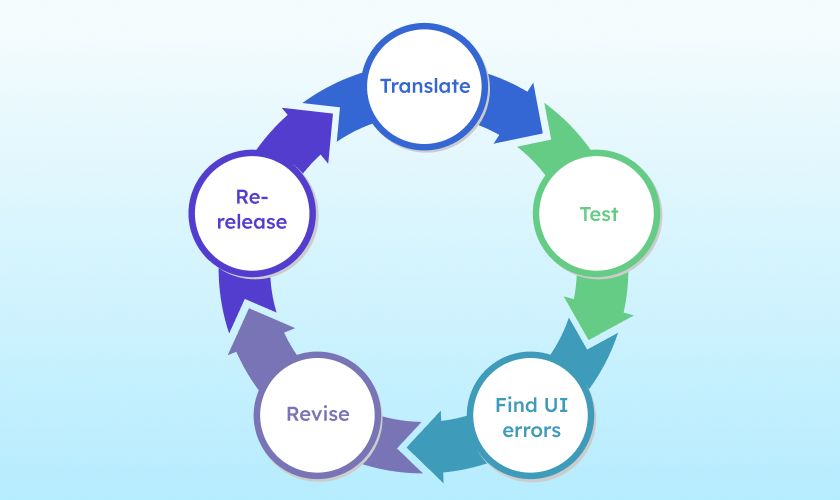
This traditional cycle of translating, testing, discovering UI issues, sending content back for corrections, and then re-releasing wastes valuable time and frustrates teams across the board. Stakeholders are all caught in a loop of repetitive work, often scrambling to fix problems that could have been prevented earlier. Contextual editing addresses these challenges at the source, enabling teams to identify and resolve potential issues before they reach the product or end users.
With contextual editing, translators can immediately see how much space they have for each string, ensuring that button labels, menus, and other interface elements fit perfectly without truncation or awkward wrapping. They can also make more informed linguistic choices: gender, plural forms, idiomatic expressions, and culturally sensitive wording can all be selected correctly when the surrounding text and interface context are visible.
Reviewers also benefit, gaining a holistic view of the content in its complete interface environment rather than evaluating isolated strings. This makes it easier to ensure consistency, spot errors, and verify that translations maintain the intended tone and meaning across screens. Meanwhile, designers can confirm that the interface holds a polished and visually balanced appearance in every language, avoiding layout issues that would otherwise require last-minute fixes.
The combined effect of these improvements is significant: translations are higher quality from the very start, feedback loops are shorter, and localization projects move faster from draft to launch. Teams spend less time correcting mistakes and more time focusing on delivering a seamless, globally ready user experience.
AI now handles a significant portion of the translation workload, but accuracy still relies on context. AI outputs better translations that require minimal human correction by providing screenshots, interface previews, and detailed notes.
Even AI-powered workflows depend on human insight and contextual awareness. Learn how human-in-the-loop translation brings AI and linguists together for smarter localization.
Context helps both humans and AI alike. Discover how AI localization enhances workflows and translation accuracy.
LingoHub combines contextual editing and automated workflows: translators focus on fine-tuning, while AI handles bulk translation accurately and efficiently. This reduces repetitive QA tasks and accelerates the localization process.
To fully leverage contextual editing:
Provide screenshots and notes from the start of the development cycle.
Prepare style guides and glossaries that support translators.
Ensure all stakeholders have access to the same previews and context.
Integrate translations directly with source repositories for seamless updates.
Syncing files automatically is crucial for maintaining consistent context and accuracy. TMS integrations enable seamless, automated localization workflows.
LingoHub makes these steps effortless: contextual previews are built into the platform, progress is tracked in one place, and developers, managers, and translators all work in sync.
Contextual editing transforms translation from guesswork into precision work. It improves translation quality, reduces rework, accelerates time-to-market, and strengthens cross-team collaboration.
In a globalized world where user experience drives success, context is essential. With tools like LingoHub that provide screenshots, additional notes, and workflow integrations, companies can deliver translations that are accurate, culturally appropriate, and ready for real-world use, especially in AI-driven localization workflows. Read more about how LingoHub provides additional context, or try LingoHub for free.
Language switching in business contexts
Language switching is common for multilinguals in work settings. Explore how code-switching impacts business and global teams in our detailed article.
Why is context important in localization?
Keep localization teams synchronized by sharing product context. Learn how better context improves collaboration, translation quality, and overall results.

Loan words, calques, and cognates
Learn more about loan words, calques, and cognates in this blog article, including true cognates, false cognates, and false friends in translation.
