Mobile content management for global apps: 2026 guide
Product localization

Table of content

Mobile content management is the operating system for how modern apps communicate with users. In 2026, release cycles are faster, personalization is expected, and every market demands language-accurate, context-aware experiences. A strong mobile content management approach keeps product, marketing, and localization teams aligned while shipping updates at the pace of mobile growth.
Mobile experiences compete in seconds. Slow updates, inconsistent terminology, or region-specific mistakes lead to churn, lower conversion rates, and higher support volume. Mobile content management helps teams move faster without losing control across languages, markets, and devices.
Mobile content management is the process and technology used to create, organize, govern, localize, and deliver content for mobile experiences. This includes in-app UI text, onboarding flows, help content, push notifications, and rich media. The goal is to make mobile content easy to update, easy to translate, and safe to ship across markets.
A mobile content management system centralizes app content so teams can edit and publish updates without rebuilding the app for every text change. It also supports structured content models, permissions, approvals, and versioning, so changes stay consistent across environments.
Common content types managed in a mobile content management system include:
Microcopy, such as button labels, error messages, and settings text
In-app messages such as tooltips, banners, and onboarding steps
Push notifications with locale-specific wording and deep links
Media assets, such as images and video variants optimized for devices
The stakes are higher on mobile because the screen real estate is smaller and user patience is thinner. On mobile, a minor translation error or a slow-loading image is a friction point that leads to immediate uninstalls.
Mobile content changes faster than desktop content because app teams ship continuously. Without a centralized system, small inconsistencies rapidly snowball: outdated onboarding text or mismatched pricing across regions.
Centralizing operations into a mobile CMS improves speed and governance across markets. To understand why providing a native-feeling experience is the only way to survive nowadays, read our analysis on why English-only content just won’t cut it anymore.
A dedicated system becomes critical when your operational complexity outpaces your manual capabilities. If you identify with any of the following, a mobile CMS is no longer optional:
You ship weekly or daily releases: Rapid deployment cycles require a system that decouples content updates from binary code releases to avoid constant “app update” fatigue for users.
You support multiple locales or plan to expand internationally: Managing localized strings across dozens of regions is impossible without a central hub that ensures the right message reaches the right user.
Multiple teams edit content and need approvals: As teams grow, you need robust governance workflows to ensure that marketing, product, and legal teams can collaborate without overwriting each other’s work.
You run experiments and need controlled content variations: a mobile CMS lets you toggle different content versions for A/B testing or personalized segments without hard-coding variables.
You want to update copy quickly without engineering bottlenecks: Empowering non-technical team members to fix typos or update promotional banners frees up your developers to focus on core feature logic.
Mobile content management solutions vary, but the best ones share a few essentials that support scale.
API-first delivery: Look for content delivered via fast APIs that support apps, the web, and any embedded surfaces. This keeps content reusable and consistent across platforms.
Structured content models: Structured fields such as title, CTA, and disclaimer reduce errors and simplify localization. Structure also improves searchability and governance.
Versioning and environments: Release-safe content changes require staging, production controls, and the ability to roll back. Versioning also supports audits and compliance needs.
Roles, permissions, and audit trails: A mature workflow needs role-based access controls, approval steps, and a clear history of who changed what, when, and why.
Localization readiness: If global scale matters, localization cannot be a manual export process. You want integrations that support translation memory, glossary enforcement, in-context review, and automated handoffs to linguists.
Get a deeper understanding of how translation memory and terminology control reduce review cycles in this blog article about CAT workflows.
In 2026, the bottleneck is rarely writing content. It is moving content through review, localization, and release without delays.
A modern workflow connects:
Product and design systems where strings originate
A mobile content management system that stores and serves content
A translation management system like LingoHub to localize continuously
Continuous localization works best when you can measure where you are today and where you want to be next. A simple way to align stakeholders is to use a maturity framework before choosing tooling.
This setup reduces manual copy-paste work, improves consistency across languages, and keeps releases moving even as the number of markets grows.
Track outcomes that reflect speed, quality, and user impact.
Operational metrics:
Time from copy update to production
Localization turnaround per locale
Number of hotfix content changes per release
Experience metrics:
Onboarding completion by locale
Retention by region and language
Conversion rate changes after localized updates
Quality metrics:
Linguistic QA issues found in the app
Support tickets are tied to unclear wording
Consistency of key terms across surfaces
LingoHub helps teams localize mobile content at scale by connecting your content sources to a translation management system that supports workflow automation, terminology control, and continuous localization. When your mobile content management system feeds LingoHub, translators and reviewers can work faster with the right context, and localized updates can return to production with fewer delays.
Mobile content management is a growth lever for global apps because it turns content into a system you can govern, localize, and ship continuously. The right mobile content management solutions combine structured content, release-safe workflows, and localization automation so every market gets the same high-quality experience.
Ready to scale multilingual mobile content faster? Connect your mobile app content management system to LingoHub and streamline mobile localization from creation to release.
This checklist ensures your chosen system supports a high-velocity, multilingual mobile strategy. Have your Lead Mobile Engineer and Head of Localization rate each item for each vendor on a scale of 1 to 5. In 2026, missing a few core capabilities, especially over-the-air updates and ISO compliance, often leads to avoidable technical debt on an international scale.
Architectural foundations
API-first headless delivery: Does the system offer GraphQL or REST APIs for global delivery?
SDK availability: Are there native SDKs for iOS (Swift), Android (Kotlin), and cross-platform frameworks (Flutter, React Native)?
Edge caching: Does the system use a global CDN to serve content from the edge and reduce time-to-first-byte for international users?
Offline persistence: Does the SDK support local caching so content remains accessible during poor connectivity?
Localization and global reach
ISO code compliance: Does the system support ISO 639-1 language codes and ISO 3166-1 alpha-2 region codes? Ensure your dev team checks the LingoHub guide on language codes.
Pluralization support: Can the system handle complex pluralization rules, especially for languages like Arabic, Polish, or Russian?
RTL support: Is the UI and delivery engine optimized for right-to-left languages such as Hebrew, Arabic, or Farsi?
Direct translation integration: Can the MCMS sync directly with your translation management system? Strategy: Connecting to a tool like LingoHub supports continuous localization and CAT workflows.
Content governance and workflows
Structured content models: Can you define custom content types, such as Promotion Card or System Alert, with validation rules?
Branching and versioning: Does the system support content branching aligned with your Git branches and release process?
Role-based access control: Can you limit translator access by locale and restrict developer access by environment?
Audit logs: Does the system track every change made to a string or asset for compliance and troubleshooting?
Mobile-specific performance
Over-the-air updates: Can UI strings be updated instantly without an App Store or Play Store release?
Dynamic asset transformation: Does the system automatically resize images and transcode videos based on the requesting device?
Push notification orchestration: Is there a dedicated API for managing localized push payloads and deep links?
AI and automation
AI content tagging: Does the system auto-tag assets for improved searchability and reuse?
Predictive prefetching: Does the SDK predict what content the user needs next and download it in advance?
Automated quality assurance: Are there built-in checks for overflow issues like text that is too long for mobile UI?
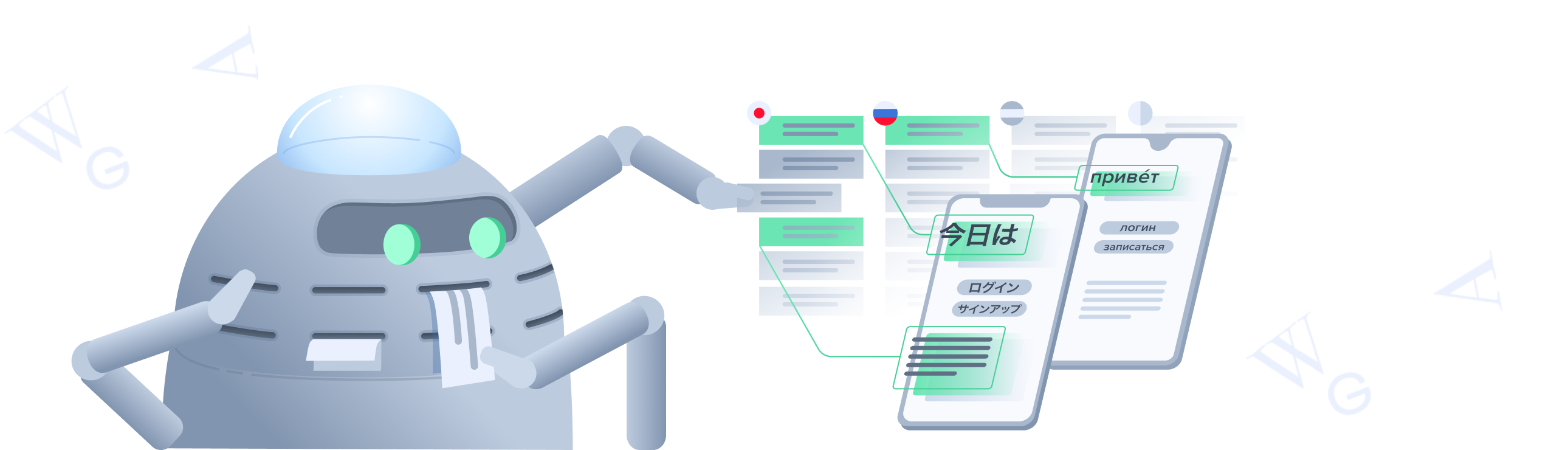
GitHub App, OTA updates, and localization features
Discover the latest LingoHub updates, including GitHub App support, Over the Air Updates, and new features that streamline software localization.

The importance of formal vs informal speech in web and mobile software
Formal or informal language? Learn why choosing the correct tone and maintaining consistency across your project is fundamental in localization.
Mobile app localization in 2025: Best practices for global success
Master mobile app localization in 2026 with best practices to adapt your app linguistically, culturally, and visually, boosting global user engagement.

How to localize mobile apps on a tight budget
LingoHub team prepared the list of tips for effective localization without extra expenses. Find more info about inside the blog.
