Localization workflows & operations
Five benefits of professional translators for business
Localization workflows & operations

Table of content

Companies expanding into international markets need more than translated words. Professional translation services help preserve meaning, terminology, tone, and context across languages, especially for technical, legal, medical, marketing, and product content.
Modern translators use technologies such as CAT tools, translation memories, terminology databases, machine translation, and AI-assisted workflows to improve efficiency. Their value lies in combining these tools with linguistic expertise, subject-matter specialization, cultural understanding, and quality assurance.
Professional translation is one part of a broader global strategy that can include a clear localization strategy, effective multilingual SEO, and reliable methods for measuring translation effort.
This article explains how to identify a professional translator, which benefits professional translation services offer, where to find qualified language specialists, and how LingoHub supports the translation process.
Before hiring a translator, companies should evaluate their expertise, communication, and professional experience. The following signs can help identify a qualified language specialist:
Relevant specialization: Professional translators frequently specialize in one or more areas, such as software, UX, finance, medicine, law, marketing, or technical documentation. Ask about their experience with your industry, content type, terminology, and target audience. A translator who claims to handle every subject equally well may not have the expertise required for specialized content.
Clear communication: Qualified translators ask questions about the product, audience, context, terminology, tone, deadlines, and review process. They should also communicate potential ambiguities and explain when additional information is required to produce an accurate translation.
Verifiable experience: Translators may provide qualifications, certifications, anonymized work samples, references, or testimonials where confidentiality agreements permit. Membership in a recognized professional association can provide another useful indicator of professional experience.
These criteria do not guarantee quality on their own, but they provide a stronger basis for evaluating potential translators before assigning a project.
1. Lower correction and rework costs
Experienced translators can identify terminology risks, unclear source text, formatting requirements, and potential ambiguities before they cause larger problems. Accurate initial translations can reduce avoidable revision cycles, internal review effort, and the cost of correcting content after publication.
2. Faster and more reliable delivery
Professional translators are familiar with CAT tools, translation management systems, translation memories, glossaries, and structured review workflows. This experience can reduce onboarding time, simplify collaboration, and help teams deliver multilingual content according to planned release schedules.
3. Greater customer trust
Customers can notice unnatural sentence structures, inappropriate terminology, or wording that does not fit their market. Professional translators adapt meaning and language to the intended audience, helping companies deliver content that feels clear, credible, and appropriate for local customers.
4. Consistent brand voice and user experience
Professional translation requires more than grammatical accuracy. Translators must apply the same terminology, tone, writing style, and product language across websites, applications, support content, and marketing materials. Glossaries, style guides, and translation memories help language specialists maintain these decisions throughout the project.
5. Better handling of specialized content
Experienced translators can manage complex terminology, regulated content, technical formats, and market-specific language requirements more efficiently. Their expertise reduces the amount of coordination required from product, marketing, engineering, and localization managers.
Companies can find professional translators through several channels. The right option depends on the number of languages, project volume, subject complexity, required turnaround time, and level of project management support.
Translation agencies: Suitable for multilingual projects that require several translators, centralized project management, and structured quality assurance.
Freelance marketplaces: Platforms such as Upwork, ProZ, and TranslatorsCafe can help companies find individual language specialists. Experience, references, specialization, pricing, and availability should be reviewed carefully.
Professional associations: Directories maintained by organizations such as the Chartered Institute of Linguists and the International Federation of Translators can help companies identify qualified professionals.
Referrals and industry events: Recommendations from trusted partners, professional networks, and niche conferences can be valuable for specialized or confidential projects.
Translation management platforms: Platforms such as LingoHub can connect professional translation services with existing localization content, terminology, context, and workflows.
Before selecting a provider, compare subject-matter expertise, target-language qualifications, confidentiality terms, supported file formats, pricing, turnaround times, revision policies, and quality assurance processes.
You are in the right place if you are looking for a professional translation or proofreading service.
As a translation management service provider, we understand how challenging and long-term the hiring process can be, especially when translated content is needed “by yesterday.” To simplify localization workflow for LingoHub customers, we organized the ability to order professional translations or proofreading inside the app. Such an approach allows the following:
Avoid the translation files transferring: All you need to do is choose the project for which you want to order service and select the text segment status(es) and label(s) if needed.
Avoid the lack of context: Don’t care about context sharing - LingoHub provides the data from your glossary and style guide. Additionally, you can add all the needed information to the order description and set the quality rules with the quality checks feature.
Avoid hidden fees: When you create a translation order request, you will get the exact price based on the number of words you selected. No “surprises” at the final stage.
Avoid missed deadlines: Set the priority to high to get needed results faster.
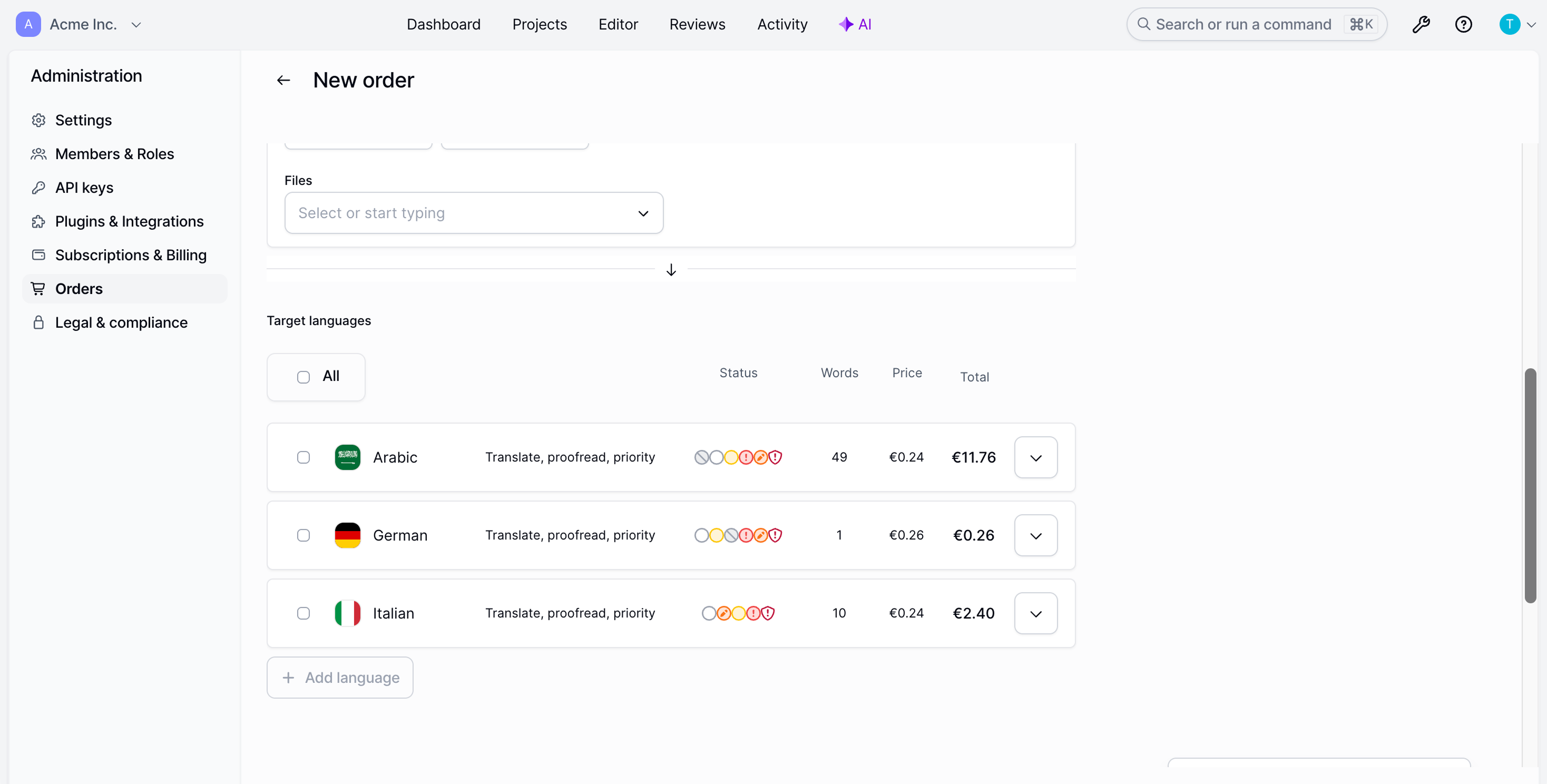
LingoHub connects professional translation services with the broader localization workflow, including repository integrations, terminology management, contextual information, automated quality checks, and project-level progress tracking.
Professional translation and proofreading are available for more than 50 languages, including:
Hindi
Vietnamese
Malayalam (India)
Finnish
Ukrainian
French
Brazilian Portuguese
and much more
Professional translation services help companies communicate accurately across markets while maintaining terminology, brand voice, cultural relevance, and content quality. The right translator should combine linguistic expertise with relevant subject knowledge, clear communication, and experience using modern translation technology.
LingoHub helps teams manage multilingual content and access professional translation services within the same localization workflow. Teams can provide context, manage terminology, review content, and coordinate translations without relying on disconnected file exchanges.
Try LingoHub for free or book a demo to discuss your professional translation and localization requirements with our team.
Professional translation services convert content into another language using qualified language specialists, relevant subject expertise, contextual information, terminology management, and quality assurance.
Companies should evaluate industry experience, target-language skills, communication, qualifications, confidentiality practices, pricing, availability, and the translator’s review process.
Machine translation generates translations automatically. Professional translation services add linguistic review, subject expertise, terminology management, cultural adaptation, and quality assurance.
Professional translation is particularly valuable for legal, medical, technical, regulated, creative, customer-facing, and high-visibility content where errors may affect trust, usability, compliance, or revenue.

5 tools for translators
Translation is no longer a hassle. Check out this article to learn about five tools that can increase productivity for translators.

A beginners guide to LinkedIn for translators
Start your development on LinkedIn as a pro. The LingoHub team prepared the best practices combined in the guide. Click and read more

Cheat sheet: Twitter hashtags for translators
Get the most important Twitter hashtags for translators, localization, and translation. Use this cheat sheet to follow industry discussions and events.

Communication matters - Interview with translator Petra Junge
Read the interview with professional translator Petra Junge and discover her insights on translation, freelancing, continuous learning, and communication.
