Financial translation in 2026: AI and compliance
Product localization
Table of content

Financial translation helps global teams publish reports, file disclosures, and localize fintech products with accuracy and consistency. In 2026, faster cycles and AI financial reporting increase the need for controlled terminology, reliable review workflows, and audit-ready traceability.
A robust Translation Management System (TMS) acts as the central control hub for financial localization. By leveraging translation memory, teams can ensure that previously approved language from past reporting periods is reused accurately. Furthermore, a TMS enforces the use of mandated IFRS terminology, proactively reducing the risk of discrepancies across all language versions.
Financial translation is becoming a core part of how global finance teams ship reports, launch products, and stay audit-ready. As AI financial reporting accelerates timelines and regulators expect clearer disclosures across markets, accuracy and terminology consistency matter more than ever. The teams that scale well treat language as structured financial data, managed with the same discipline as numbers.
Financial translation is the professional translation of financial and accounting content, preserving meaning, intent, and numeric context. It covers terminology, legal phrasing, reporting conventions, and formatting expectations that vary by market.
It also includes consistency controls to ensure the same financial concept is expressed consistently across every document, dashboard, and filing.
Financial translation services are most relevant for organizations that publish, file, or sell across borders. Common examples include:
Public companies translating annual reports, management commentary, and investor presentations
Finance teams translating IFRS* translation materials and accounting policy notes for global stakeholders
Banks and insurance companies translating disclosures, product terms, and risk statements
Fintech companies engaging in localization for apps, onboarding flows, and in-product financial content
Mergers and acquisitions teams translating due diligence packs and deal documentation
Audit and compliance teams translating workpapers, internal controls narratives, and regulator responses
ESG and sustainability teams translating disclosures that influence investor trust
*International Financial Reporting Standards
Financial translation also helps prevent costly downstream fixes, such as restatements, delayed filings, or investor confusion, by ensuring meaning is preserved across languages. In practice, it turns multilingual reporting from a risk factor into a controlled process that finance teams can rely on under tight deadlines:
Compliance confidence: A small terminology shift can change how an obligation, risk, or revenue treatment is interpreted in another jurisdiction.
Investor clarity: Global investors and analysts expect consistent language across markets so they can compare performance and risk without ambiguity.
Audit readiness: Auditors look for consistent definitions, stable terminology, and traceability across versions. Translation quality directly affects that consistency.
Operational speed: As reporting cycles shorten, teams need repeatable workflows that reduce rework and keep approvals moving.
Today, the gap between a good translation and a precise one is measured in basis points and legal fees. Financial language is high context. A single term, such as “Liability versus Provision” or “Revenue Recognition versus Deferred Income”, carries specific legal weight under IFRS translation and GAAP expectations.
A mistranslation is more severe than a simple typo. It is a data integrity failure that can trigger regulatory red flags.
AI speeds up drafting and helps teams process large volumes of content, especially for recurring sections and structured reporting text. This is where AI financial reporting and AI-assisted translation workflows deliver the most value.
Human financial linguists and reviewers remain essential for terminology governance, accounting context, and jurisdiction-specific nuance. This is especially true for disclosures, risk language, and anything tied to audit sign-off.
Financial translation spans every artifact that shapes how performance, risk, and obligations are understood across borders. The common thread is stakes: these materials either carry regulatory weight, influence investor decisions, or underpin audit evidence, so accuracy and consistency are mandatory.
Below are the content types where terminology control, traceability, and formatting discipline matter most:
Annual and quarterly reports: High visibility content where consistency across periods matters.
IFRS and accounting policy notes: Terminology precision is critical because definitions carry legal and financial meaning.
Investor relations materials: Decks, press releases, and shareholder communications need clarity and tone control.
Fintech product content: Fintech localization requires correct currency formats, payment terminology, and user-facing trust language.
Audit and compliance documentation: Workpapers, regulator correspondence, and internal controls narratives require strict consistency.
In the 2026 landscape, your financial data is one of your most sensitive assets and a major liability if mishandled. While generative AI has improved drafting speeds, using public AI models for financial translation creates a real risk of data leakage, where proprietary figures and narratives could be exposed or used to train external systems.
LingoHub addresses these sensitivities with a security-first architecture, providing an encrypted, SOC2 Type II-compliant environment where your data remains under your exclusive control. Private AI workflows ensure that sensitive quarterly results and M&A documents are processed securely, without ever being used to train external public models, thereby protecting your global reputation.
A TMS allows finance departments to centralize terminology, approvals, and audit trails across diverse languages and business units. With LingoHub, teams utilize translation memory to reuse approved reporting language, significantly reducing costs and preventing “terminology drift” between quarterly cycles.
Strict governance: Built-in terminology tools maintain consistency in accounting concepts by approving specific terms and blocking unauthorized variants.
Audit-ready workflows: Designed for transparency, these workflows offer role-based approvals, tracked changes, and full version history, providing the traceability auditors and regulators require.
Financial translation teams perform best when they treat language like a controlled system, not a one-off task. These best practices help you reduce risk, improve consistency, and speed up cycles without sacrificing accuracy.
Create a finance term base first: Start with your chart of accounts language, key accounting terms, and disclosure phrases.
Standardize numbers and formats: Define rules for decimals, thousands separators, currencies, and date formats by locale.
Separate high-risk content for deeper review: Disclosures, risk statements, and policy notes should be reviewed more rigorously than routine content.
Measure quality with repeatable checks: Use terminology validation, numeric consistency checks, and structured reviewer feedback.
In modern finance, quality must be managed as a system rather than treated as a reactive task. By utilizing a TMS for automated quality checks, such as numeric validation (decimals and separators) and terminology compliance, finance teams can speed up approval cycles and ensure every communication meets boardroom standards.
In 2026, financial translation sits at the intersection of compliance, speed, and trust. Teams that combine strong terminology governance with efficient workflows and AI-assisted support can scale global reporting without losing the precision of finance demands.
To deepen your understanding of the regulatory landscape and the technical requirements of financial translation in 2026, we recommend the following independent resources:
Legal case studies & arbitration
Occidental Petroleum v. Republic of Ecuador (ICSID Case No. ARB/06/11): Highlights how translation discrepancies in Supreme Court judgments led to a multi-billion dollar valuation error. A cornerstone case for legal-financial translation risk.
Regulatory reporting & accounting standards
IFRS 18 and IFRS 19 implementation guides: These standards dictate the exact terminology required for global compliance.
ESEF reporting manual (2025/2026 Update): The European Securities and Markets Authority (ESMA) provides the technical specifications for inline XBRL (iXBRL). This is critical for understanding how translated text must align with machine-readable financial tags.
AI governance & digital transformation
The EU AI Act - Compliance for Financial Services: As of 2026, the AI Act’s provisions for “High-Risk” AI systems are fully enforceable. Review the transparency requirements for AI-generated financial disclosures and the “Human-in-the-Loop” mandates.
International standards
ISO 20022: Essential for FinTech teams to understand how payment data and messaging are standardized globally, reducing the risk of character-set and formatting errors in cross-border transactions.

AI localization: Supercharge your translation workflow
AI localization uses artificial intelligence to streamline translation workflows, improve quality, and scale global content faster. Learn more in our blog.
Approaching lean translation management for localization
Discover the lean translation management process. Learn how it ensures agility, speed, and cost savings to optimize your workflows.

Web app localization: Best practices and workflow
Learn how to localize a web app with internationalization, string management, RTL support, continuous localization, QA, and release-ready workflows.
Beyond the basics: Navigating language codes for true localization
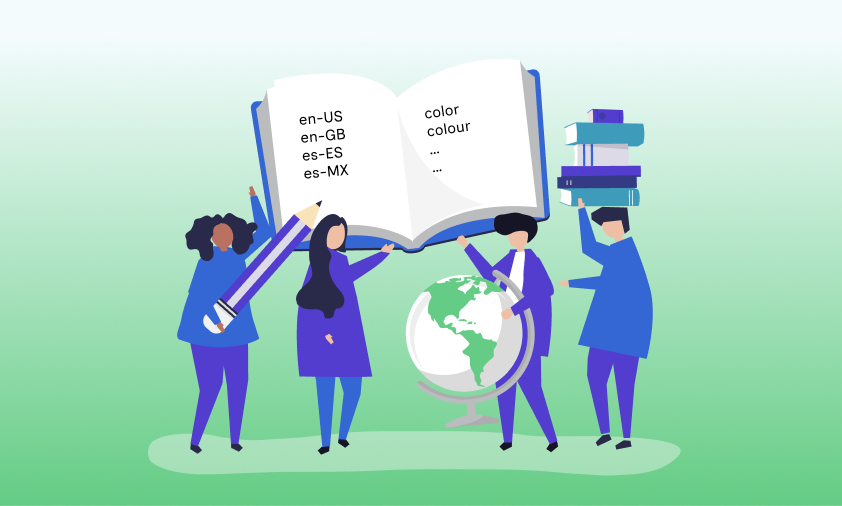
Language codes are the backbone of true localization. Discover how ISO 639 standards and regional variants shape global user experiences in our blog article.
