A farewell to the CAT tools, a warm welcome to the l(A)Ion


)

For decades, CAT (computer-assisted translation) tools sat at the center of professional translation workflows. They brought structure to what had once been a fragmented and manual process. Translation memory reduced repetitive work, terminology databases ensured consistency, and segment-based workflows helped teams maintain quality across languages and projects.
These tools transformed the language industry by making translation more efficient, scalable, and predictable. For a long time, that was exactly what localization teams needed.
But localization has changed. Today's global products ship continuously, content is created at unprecedented speed, and businesses expect multilingual experiences to keep pace with every release. Translation has become an always-on business operation embedded in product development, customer support, marketing, and AI-powered content creation.
This shift raises an important question: are traditional CAT tools still enough for modern localization?
Their core capabilities, translation memory, terminology management, and linguistic quality control, remain valuable. But the environment around them has evolved. AI-powered translation, automation, and integrated localization platforms are changing how multilingual content is created, managed, and delivered.
The old CAT helped the industry bring order to complexity. As localization enters the AI era, however, a new player is emerging, one built to orchestrate language operations at scale. That is the moment the l(A)Ion appears.
Why the CAT (tools) ruled for so long
Before exploring this new era, it is worth remembering why the previous model lasted so long. Computer-assisted translation worked because it solved real business problems at exactly the right time. In a world where content moved in batches and translation cycles were easy to plan, these tools brought rigor, reuse, and consistency to enterprise teams.
This predictability was incredibly valuable for companies dealing with specialized terminology. A technical product description, a medical instruction, or a legal clause cannot drift casually from one version to the next. The software gave language teams a firm grip on precision, and because human translators carried out the work, the system kept human effort organized and efficient.
Why did the ground beneath CAT (tools) shift?
The value of consistency never changed, but the scale and speed of the modern business world did. Today’s multilingual operations look entirely different from the environment where traditional frameworks first became indispensable. Enterprises now publish continuously, product copy evolves in real time, and marketing teams localize campaigns across channels simultaneously.
This velocity makes older, segment-centered workflows feel incredibly heavy. Teams often maintain their organized processes but still miss deadlines. They align terminology but struggle with rising costs. The traditional tools know how to hunt, but they are suddenly operating in a world that has grown much louder, faster, and more crowded.
Beyond the assistant: Computer-assisted translation in a broader operational context
Traditional tools were built to assist human effort, supported by memory, segmentation, and process discipline. While that foundation remains valuable, it now sits inside a much larger operational picture shaped by automation, deep system integration, and massive content flows.
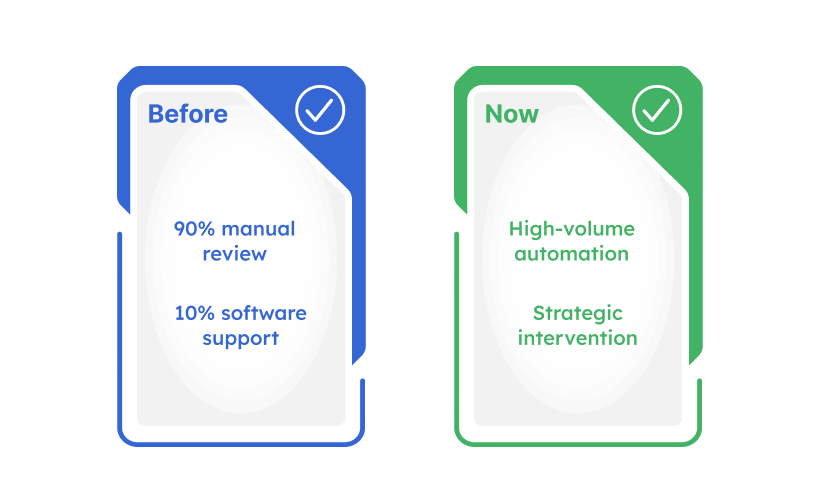
When localization leaders look beyond purely linguistic questions and focus on operational efficiency, priorities change. Managing thousands of continuous strings requires asking where human expertise has the greatest impact and which manual steps exist simply because the old process assumed they would always be needed. This is where the lion becomes impossible to ignore, rewriting the expectations of the entire industry.
The shift in AI-driven translation work
The biggest change lies in how daily work gets distributed. In a traditional model, human attention spreads evenly across nearly every sentence. An AI-driven model establishes a different starting point, where machine output handles the entire first pass, allowing human involvement to be deliberate, selective, and focused on nuance.
This transforms the economics of translation. While a regulatory clause or a complex product promise still requires careful human review, a vast amount of high-volume content does not. Teams can finally shape their workflows around risk, value, and complexity, allowing the production engine to move with force where force matters most.
Why agencies are being nudged out of old habits
For translation providers, this new era alters long-standing assumptions about how work should be staffed, priced, and delivered. Enterprise clients expect faster delivery timelines and broader language coverage without massive budget expansions, forcing agencies to look beyond traditional manual throughput.
The service providers building sustainable futures are focusing their energy where human judgment carries genuine weight. They are stepping into strategic roles, specializing in terminology governance, quality assurance, domain-specific review, and global language strategy.
Why enterprises are rethinking the center of the stack
Inside large organizations, translation rarely behaves like an isolated linguistic project. It sits directly in the middle of fast-moving product launches, support updates, compliance reviews, and regional marketing plans, meaning that operational friction mainly comes from coordination rather than language itself.
| Operational Layer | Traditional Desktop Frameworks | Modern Orchestration (LingoHub) |
|---|---|---|
| Data Ingestion | Manual file exports and handoffs | Continuous repository and API integrations |
| Drafting Engine | Manual segment-by-segment translation | Instant AI drafting with contextual guardrails |
| Quality Control | Retrospective human editing cycles | Real-time automated terminology enforcement |
This reality is driving enterprises to look past legacy tools as their central organizing layer. They still require translation memory and terminology control, but they need a flexible model that allows content to be tiered by risk. Modern platforms like LingoHub serve as the orchestrator for this environment, blending classic asset management with automated workflows to keep pace with modern product teams.
Why is CAT still around, but no longer on the throne?
The phrase "CAT is dead" flattens a nuanced reality. Translation memory, terminology management, and contextual control remain foundational to corporate identity, and those strengths do not vanish simply because machine learning has evolved.
The difference lies entirely in leadership. These classic tools no longer dictate the entire workflow; instead, they serve as the vital data feeds that guide artificial intelligence toward accurate, on-brand output. The traditional software still has an essential place in the ecosystem, but it is no longer “the active ruler”.
What the next kingdom looks like
The next localization architecture is built for rapid, multi-channel growth. AI handles foundational draft translation, while automated workflow rules dynamically direct content along priority-based paths. Human expertise enters the loop precisely where domain knowledge, brand tone, and deep stylistic nuance add measurable value.
This fluid environment is where modern platforms truly shine. By providing a unified space for translation memory, terminology management, automated software integrations, and AI-supported translation, LingoHub enables the orchestration needed to run continuous operations. For global businesses handling complex software, ongoing product updates, or rapid market expansions, this flexible approach is a natural fit for how modern companies actually build and scale today.
Final thoughts on CAT tools in the era of AI
The CAT had a good run, and deservedly so. It brought structure, consistency, and discipline to a part of the business that badly needed all three. For years, it was the right ruler for the terrain. But the terrain has changed, and the lion has settled in. AI is reshaping translation in ways that reach far beyond productivity gains. It is changing how work is divided, how costs are managed, and how localization fits into the broader machinery of enterprise growth. By now, this reality has fully arrived in the agency world and across enterprises, too.
Navigating this transition requires orchestrating AI alongside your existing linguistic assets. Modern localization platforms like LingoHub are designed for this exact reality, acting as the bridge that connects the structure of traditional CAT tools with the scale and speed of modern AI workflows.
The teams that adapt early to this hybrid model gain a highly practical advantage: a translation ecosystem built for the velocity, scale, and specificity of modern global business. The CAT still prowls the kingdom, but the lion now defines it.
Don't watch the landscape change, rule it. Learn how LingoHub tames the l(A)Ion for enterprise scale. Start a free trial or book a demo now.
Frequently asked questions
What is a CAT tool?
A CAT (computer-assisted translation) tool is software that helps translators work more efficiently and consistently. Instead of translating every sentence from scratch, CAT tools use translation memory, terminology databases, and segmentation to reuse previous translations and maintain linguistic consistency across projects.
CAT tool vs machine translation: What's the difference?
CAT tools help humans translate more efficiently by providing translation memory, terminology management, and workflow support. Machine translation generates translations automatically using AI models. In modern localization workflows, the two are often combined, with AI generating drafts and CAT tool assets providing context, terminology, and quality control.
Are CAT tools still relevant in 2026?
Yes. Translation memory, terminology management, and linguistic quality control remain essential for enterprise localization. However, CAT tools are no longer the center of the localization process. Many organizations now combine traditional CAT capabilities with AI-powered translation, automation, and integrated localization platforms.
What is translation memory?
Translation memory is a database that stores previously approved translations. When similar content appears again, the system suggests existing translations, helping teams improve consistency, reduce costs, and accelerate delivery.
Will AI replace CAT tools?
AI is changing how translations are produced, but it is not replacing the core capabilities of CAT tools. Instead, AI increasingly relies on translation memories, glossaries, and linguistic assets managed by localization platforms to produce more accurate and consistent results.